


Is Coin Relic Hunting Worth It? Honest Review
Table of Contents
- Is Coin Relic Hunting Worth It? The Honest Verdict
- The Real Costs of Getting Started
- What You Can Actually Find: Coins, Relics, and Trash
- The Best Entry Level Metal Detector for Beginners
- How to Research Sites for Metal Detecting
- Metal Detecting Laws and Regulations You Must Know
- The Bottom Line: Who Should Try Coin Relic Hunting?
- Frequently Asked Questions
Last Updated: September 7, 2026
Is Coin Relic Hunting Worth It? The Honest Verdict
Coin relic hunting is the practice of using a metal detector to search for old coins, historical artifacts, and lost jewelry buried beneath parks, fields, and forgotten homesteads. For many, the honest answer to whether it is worth it depends less on the gear and more on what you value: tangible history in your hand or a reliable return on your time.
At Treasure Coast Detectors, we have a front-row seat to who sticks with this hobby and who sells their machine after six months. The detectorists who stay engaged treat it as a low-cost outdoor activity with a bonus payout, not a get-rich scheme. If you want fresh air, light exercise, and the occasional moment of genuine awe, coin relic hunting delivers consistently.
Below, we break down the real costs, what you can actually find, and the honest math of whether this hobby pays for itself, plus the legal side most guides skip.
The Real Costs of Getting Started
The financial barrier to entry is lower than most assume, but higher than bargain-bin detectors suggest. A quality entry-level machine costs between $250 and $350 and outperforms a $99 detector in discrimination, depth, and reliability. The biggest mistake new hunters make is buying a cheap unit first, then upgrading within a year.
Beyond the detector itself, budget for a few essentials:
- A handheld pinpointer, roughly $80 to $150, to locate targets precisely once you dig
- A sturdy digging knife or trowel, $20 to $40, that will not bend on roots or hard soil
- A finds pouch and gloves, under $30 total
- Headphones, $50 to $150, to hear faint targets over wind and traffic noise
The total starter investment lands around $400 to $700 for a setup that will serve you for years, comparable to a mid-range golf club set or a season of weekend fishing trips, with no recurring fees or membership dues.
What You Can Actually Find: Coins, Relics, and Trash
The honest truth is that you will dig far more trash than treasure, especially in the first few months. Pull tabs, bottle caps, aluminum foil, and rusted nails make up the bulk of early finds. The ratio improves as you learn signal identification and discrimination settings, but it never reaches zero.
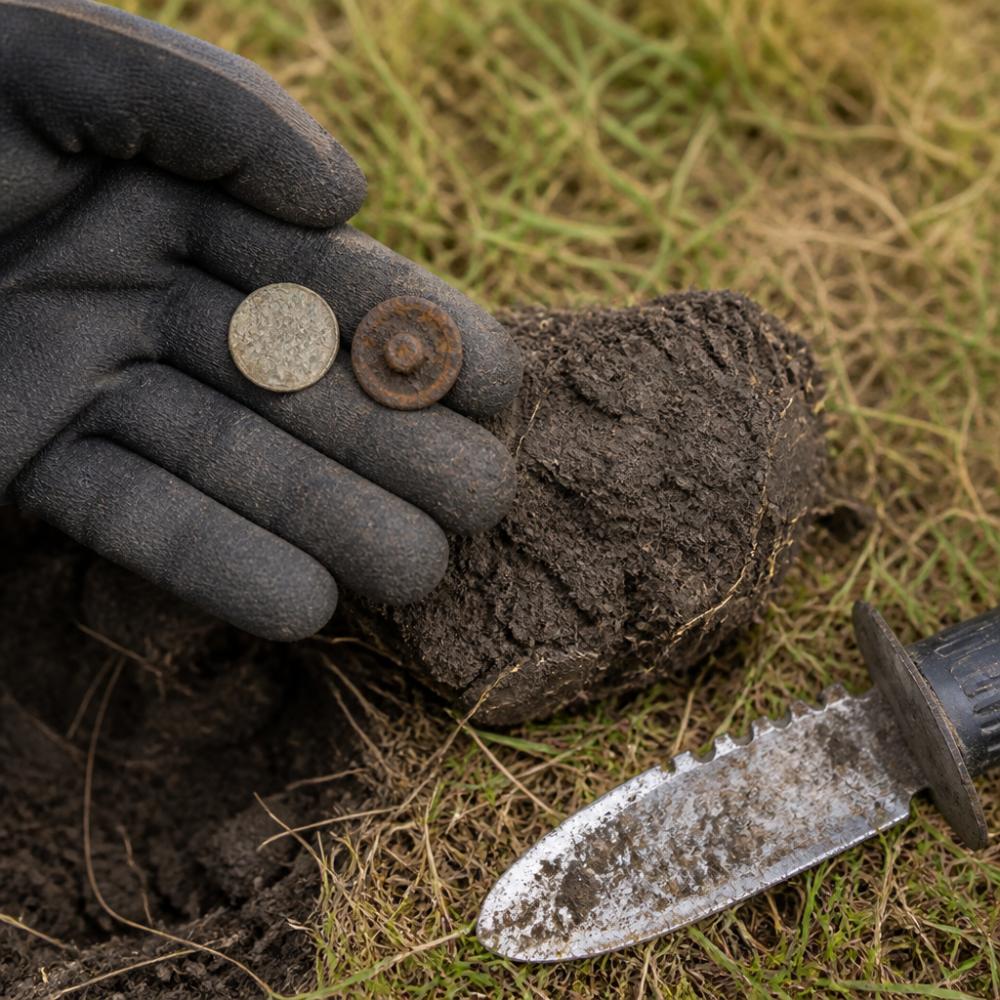
What keeps experienced detectorists engaged is the unpredictability. A typical year of weekend hunting might produce modern pocket change, a handful of wheat pennies, the occasional silver dime or quarter, and, if lucky, something genuinely old: a civil war button, a colonial-era buckle, or a silver coin from the 1800s. Some hunters go years without a significant find; others pull a rare coin on their third outing. There is no formula.
The Time-Value Math Most Guides Skip
To answer the "worth it" question honestly, you need a realistic hourly breakdown. Most beginners who stick with the hobby for a full season report digging roughly 20 to 30 targets per hour in a moderately trashy park. Of those, 80 to 90 percent will be junk, leaving roughly 2 to 4 keepers per hour, mostly clad coins worth 1 to 10 cents.
Detectorists who log their finds report silver coins (pre-1965 dimes, quarters, and halves) appear at a rate of roughly 1 per 10 to 15 hours in an average undetected park. At a site with genuine historical depth, that rate improves to 1 per 3 to 5 hours, but those sites are rare and require significant research.
In dollar terms, hunting 2 hours per weekend (roughly 100 hours per year) might recover 6 to 10 silver coins, a handful of wheat pennies, and one or two relics. Silver melt value alone would be $30 to $60; add the occasional gold ring or rare coin, and annual finds might total $100 to $300 in resale value. That is not a return on your time by any financial metric. It is a return on your curiosity. Of course all of this will depend on the locations that you choose to metal detect. So do your research. Here at beachs in Florida you can find 100’s of coins in a day. Location is everything.
The Real Value Is Not on the Price Tag
The real value is rarely monetary. A silver Washington quarter from 1942 might be worth $5 to $10 in silver content, but holding a coin that passed through hands during World War II connects you to history in a way a museum display cannot. That emotional payoff keeps the hobby alive.
There is also a measurable non-financial return. A 2-hour hunt burns roughly 300 to 500 calories, gets you outdoors, and provides active meditation hard to replicate at a desk. Compared to a gym membership or a round of golf, the $400 to $700 starter investment pays for itself in recreation value within a single season.
The Best Entry Level Metal Detector for Beginners
The best entry level metal detector for most beginners is the Nokta Makro Simplex Ultra at $299. It delivers fully waterproof performance to 16 feet, multiple detection modes, and adjustable sensitivity and iron volume control, features reserved for $600 machines just a few years ago.

What makes the Simplex Ultra particularly strong for coin relic hunting is its fast recovery speed in trashy environments. It separates adjacent targets well, letting you pick a coin out of a nail-filled cellar hole where cheaper detectors blank out. The target ID and pinpoint mode are accurate enough for beginners, and the rechargeable battery with USB-C charging removes the hassle of AA cells.
If you have more budget and want a detector that will carry you through several years of growth, the Minelab Equinox 900 at $999 is the upgrade path most hunters take. Its 119-segment target ID and superior separation in iron-saturated ground make it a serious coin and relic machine. But for a true beginner, the Simplex Ultra at $299 is the smarter financial decision.

How to Research Sites for Metal Detecting
Site selection determines your success more than any equipment choice. A $1,500 flagship detector on a hunted-out modern park will underperform a $299 machine on a forgotten 1800s picnic grove.
Start with historical maps and aerial photography. Compare modern satellite imagery against old plat maps, Sanborn fire insurance maps, and county atlases from local historical societies and university libraries. Look for structures that no longer exist, schoolhouses, churches, fairgrounds, taverns, and farmhouses on an 1890 map but gone by 1950. Those sites hold coins and relics undisturbed for a century.
Field research matters just as much as map study. Walk potential sites and look for signs of human activity: sunken depressions indicating cellar holes, concentrations of broken pottery and glass, old fence lines, and mature trees that suggest a former homestead. Public land that is open to detecting, such as county parks and school grounds built on old properties, can be surprisingly productive. The key is layering historical research with on-the-ground observation, a practice the National Park Service guidance on historical research methods outlines well for understanding how to identify and interpret historic sites.
Metal Detecting Laws and Regulations You Must Know
The legal landscape for metal detecting in the United States is fragmented, and ignorance of the rules can cost you your equipment, a fine, or worse. There is no single federal law; instead, you must navigate a patchwork of federal, state, and local regulations.
The most important distinction is between public and private land. On private property, you need explicit permission from the landowner, and you should get it in writing. On public land, the rules differ by agency. Detecting is generally prohibited in national parks, national monuments, and most national wildlife refuges under the Archaeological Resources Protection Act, which protects archaeological resources on federal lands. State parks and state forests have their own regulations, ranging from complete bans to areas where detecting is allowed with a permit. City parks and school grounds are typically governed by local ordinances, and many require permission from the parks department.
The universally accepted ethical standard, reinforced by organizations like the American Metal Detecting Association code of ethics, is to fill every hole, pack out all trash you find, and never dig at archaeological sites or historic monuments. The hobby's reputation depends on detectorists leaving no trace. When you hunt responsibly, you build goodwill that keeps public sites open for everyone.
The Conservation Obligation Most Detectorists Miss
Beyond where you can dig, there is a second layer of responsibility rarely in beginner guides: what you do with historically significant finds. In many states, artifacts of a certain age or type are considered state property, even on private land with permission. A handful of states, including Arkansas, Louisiana, and Mississippi, claim ownership of certain artifact classes regardless of land ownership. The specifics vary widely, so check your state historical preservation office's guidelines before hunting a new area.
For most finds, however, the obligation is ethical rather than legal. Archaeologists and curators strongly prefer that detectorists document the context of a significant find before removing it, recording GPS coordinates, depth, and surrounding soil conditions. This information is often more valuable to historians than the artifact itself.
If you recover something genuinely significant, a military button with a unit designation, a coin predating 1800, or any inscribed item, the responsible path is to report it to your state's archaeological office or a local historical society. Many worry this means confiscation, but most state offices are understaffed and will simply log the find. Some societies even provide a letter of provenance that increases the item's value if you sell it.
The Environmental Impact of Your Dig
A related concern growing within the community is the physical footprint of detecting. Every plug you cut disturbs soil structure, and in sensitive environments like riverbanks, wetlands, or erosion-prone hillsides, repeated digging can accelerate damage. The modern standard goes beyond "fill your holes" to "leave the ground better than you found it", cutting a clean three-sided plug, preserving the grass root system, and tamping it back firmly.
It also means being selective about where you dig. A site with visible erosion, active archaeological work, or sensitive vegetation should be off-limits regardless of signage. The hobby's long-term survival depends on detectorists being seen as stewards rather than scavengers.
The Bottom Line: Who Should Try Coin Relic Hunting?
Coin relic hunting is worth it if you value outdoor time, historical connection, and the possibility of discovery more than a guaranteed financial return. The costs are modest, the learning curve is forgiving, and the skills you build carry over into every future hunt.
It is not worth it if your primary motivation is profit. The average detectorist recovers little of monetary value, and time invested rarely translates to an hourly wage comparable to a modest side job. If you are not excited by holding a piece of history, the hobby will feel like tedious work.
For those ready to try it, start with the Nokta Makro Simplex Ultra at $299, research your local laws, and find one promising site to practice. The detectorists who succeed treat every outing as a small adventure, not an investment.
Frequently Asked Questions
Can you make a living metal detecting for coins and relics?
For almost everyone, no. A full-time income from coin relic hunting is rare and usually requires decades of experience, specialized research, and a bit of luck. Treat it as a hobby that can offset its own costs. A $299 detector like the Nokta Makro Simplex Ultra can pay for itself if you find a few silver coins and jewelry pieces per season.
What is the difference between coin shooting and relic hunting?
Coin shooting targets modern and old coins in high-traffic areas like parks, schools, and fairgrounds. Relic hunting focuses on historical artifacts such as buttons, buckles, and tools, often in fields or former homestead sites. Coin shooting favors discrimination settings to ignore iron trash, while relic hunting requires digging more targets, including iron-saturated ground, to avoid missing artifacts.
Do I need a high-end metal detector to find valuable relics?
No. A capable entry-level detector like the Nokta Makro Simplex Ultra at $299 finds coins and relics at practical depths. High-end machines like the Minelab Manticore ($1,499) offer better target separation in trashy sites and deeper penetration in mineralized soil. Start with a solid mid-range or entry model, learn proper recovery techniques, then upgrade when you hit the machine's limits.
What are the legal considerations for relic hunting on public land?
Federal laws like the Archaeological Resources Protection Act prohibit digging artifacts on federal land without a permit. State parks and local parks have their own rules; many ban detecting entirely. Your safest options are private property with written permission, designated public beaches, and your own land. Always check local metal detecting laws and regulations before you dig.
How do I identify if a found relic has historical value?
Look for maker's marks, dates, and material composition. Military buttons, coins dated before 1900, and tools with identifiable manufacturer stamps often have collectible or historical value. Research your state's historical society databases and compare your finds against documented examples. If you suspect a significant artifact, photograph it in place, note the GPS coordinates, and contact a local archaeologist for guidance.
Leave a comment