

How to Tell if a Gold Coin Is Plated: 8 Tests
Table of Contents
- Why Gold-Plated Coins Fool So Many Detectorists
- The Ceramic Streak Test: A Fast First Check
- Checking Hallmarks and Lettermarks Before Anything Else
- Magnetism, Weight, and Dimension Verification
- The Ping Test and Visual Inspection for Wear
- How to Test Gold Coins at Home Without Damaging Them
- The Specific Gravity Test for Gold Coins: Step by Step
- When to Use an Acid Test Kit for Gold (and When Not To)
- Frequently Asked Questions
Last Updated: September 13, 2026
Why Gold-Plated Coins Fool So Many Detectorists
Learning how to tell if a gold coin is plated matters because modern plating has gotten genuinely convincing. A thin gold layer over brass or copper can mimic the weight, color, and even the sound of a real gold coin closely enough to fool an experienced eye. This guide walks through field-tested checks, from the ceramic streak test to a calibrated specific gravity measurement, that separate a genuine gold coin from a gold-plated counterfeit.
Gold is dense. That single fact drives most reliable testing methods. A real gold coin feels heavier in the hand than its size suggests, while a plated fake hides a lighter base metal underneath. The U.S. Mint's coin specifications list official weight and diameter tolerances for government-issued coins, which gives you a baseline for comparison.
The tricky part is that plating technology has improved. A well-made fake can pass a quick visual check easily. That's why serious collectors layer multiple tests instead of trusting one.
The Ceramic Streak Test: A Fast First Check
The ceramic streak test is a non-destructive way to check a coin's surface metal by dragging it across an unglazed ceramic plate. A genuine gold coin leaves a gold-colored streak. A plated coin often reveals the base metal beneath the thin gold layer, leaving a darker or differently colored mark.
Use the unglazed underside of a tile or the rough rim of a ceramic mug. Press the coin's edge firmly and drag it a couple of centimeters. Examine the streak under good light.
A few cautions apply here. This test can leave a faint mark on the coin, so avoid it on numismatic pieces you plan to grade. For bullion or common coins, it's a quick first filter. If the streak looks gold, move on to weight and dimension checks before celebrating.
Checking Hallmarks and Lettermarks Before Anything Else
Hallmarks and lettermarks are stamped marks that identify a coin's mint, purity, and origin, and they're the fastest authenticity signal available. Before you run any physical test, put a loupe on the coin and read every mark.
Look for the mint mark, the stated fineness, and the year. A genuine U.S. gold coin carries consistent, crisply struck lettering. Counterfeiters frequently get the font weight wrong, misalign the mint mark, or produce shallow, mushy strikes.
What most guides miss is that a correct hallmark proves nothing on its own. Fake coins often carry accurate stamps copied from a real specimen. Treat hallmarks as a starting point, not a verdict.
Magnetism, Weight, and Dimension Verification
Magnetism, weight, and dimension verification is a three-part check that catches most plated fakes quickly. Gold is non-magnetic, so a strong magnet should not attract a genuine gold coin at all. If the coin sticks or drags, it contains ferromagnetic base metal.
Weight and dimensions come next. A counterfeit plated over a lighter alloy will often fall outside the official weight tolerance for that coin. Use a calibrated digital scale that reads to 0.01 grams, then compare against published specifications. Diameter and thickness matter too; a coin that's slightly too thick usually has a plating layer or a tungsten core.
| Check | What to Look For | Red Flag |
|---|---|---|
| Magnetism | No attraction to a strong magnet | Coin sticks or drags |
| Weight | Matches official spec within tolerance | Off by more than a few tenths of a gram |
| Diameter | Matches published measurement | Noticeably oversized or thick |
| Thickness | Consistent edge profile | Bulging or uneven rim |
The Ping Test and Visual Inspection for Wear
The ping test uses sound to gauge a coin's metal composition. Balance a genuine gold coin on your fingertip and strike it lightly with another coin or a pencil. Real gold rings with a long, clear, high-pitched tone that sustains for a second or more. A plated base-metal coin produces a duller, shorter sound.
Sound analysis has limits. A tungsten-cored fake can ring convincingly because tungsten's density is close to gold's. Never rely on the ping test alone.
Visual inspection for wear and discoloration catches what sound misses. Genuine gold coins age gracefully, developing a warm patina without flaking. Plated coins often show tarnish at high points, discoloration along the rim, or tiny bubbles where the plating didn't bond. Look at the edges under magnification; plating frequently wears thin there first.
How to Test Gold Coins at Home Without Damaging Them
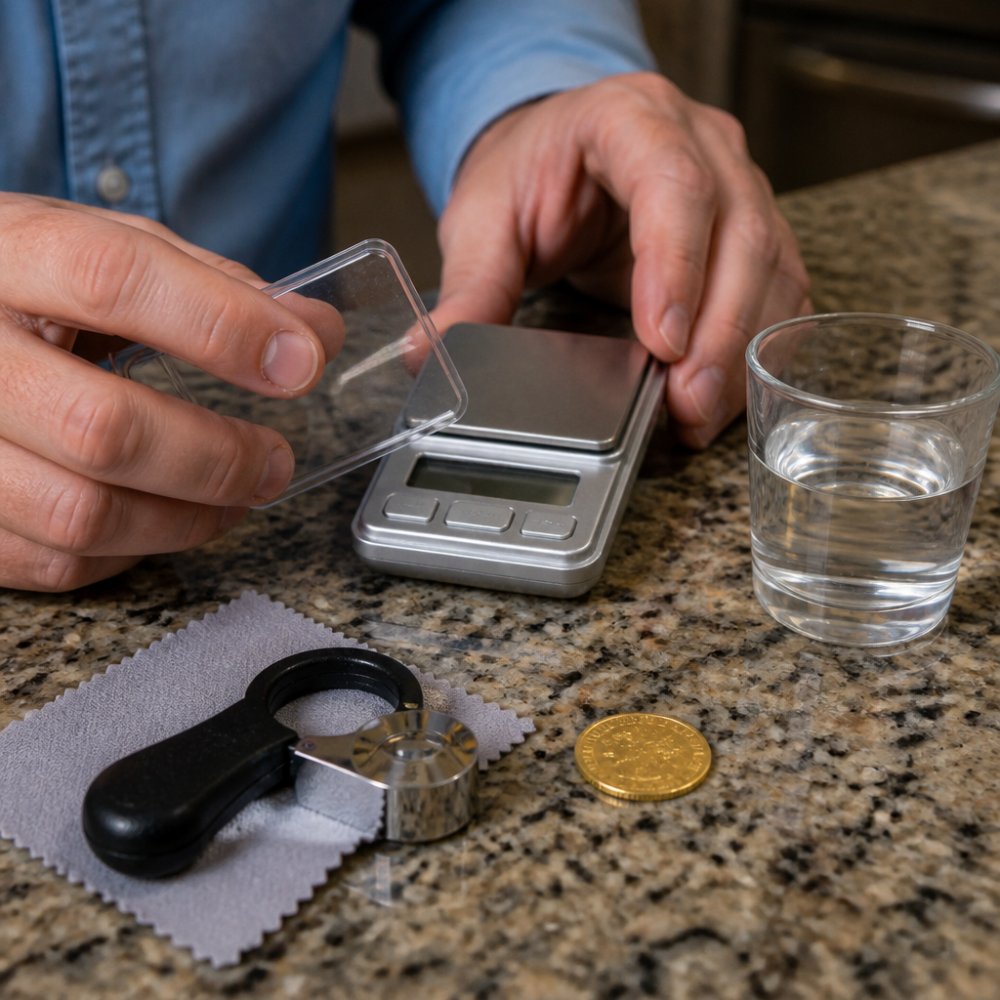
Testing gold coins at home without damaging them means separating two very different goals: confirming bullion metal content, and preserving numismatic value. A coin's collector premium lives in its surface, original luster, strike detail, and the absence of hairlines or rim nicks. Every rub, scratch, or acid drop is permanent. Most guides bury that trade-off. Here it drives the entire order of operations.
Non-destructive tests (safe for any coin):
- Visual inspection under 10x magnification, look for plating bubbles, rim wear, and color shifts at high points
- Hallmark and lettermark reading with a loupe
- Magnetism check with a strong rare-earth magnet
- Weight on a calibrated digital scale (0.01 g resolution)
- Diameter and thickness with digital calipers
- The ping test on a soft, padded surface
- Specific gravity via water displacement (covered in the next section)
Semi-destructive and destructive tests (bullion or common coins only):
- Ceramic streak test, leaves a faint abrasion line
- Acid test kit, etches the surface and can strip plating
A common mistake is reaching for the streak test or an acid kit first because they feel decisive. On a coin that might grade, that instinct can wipe out most of its premium. A common pattern among experienced collectors is to run the full non-destructive stack first and only escalate if the coin fails a weight, dimension, or specific gravity check.
Handle coins by the edge, over a soft cloth, and never on a hard countertop. Even a short drop onto tile can flatten a rim and knock a coin out of a high grade. Nitrile gloves or clean cotton gloves reduce skin oils that dull luster over time.
If the coin is potentially numismatic, graded, or investment grade, stop at the non-destructive stage. Specific gravity testing and a professional appraisal are the right next steps; anything that alters the surface is not.
The Specific Gravity Test for Gold Coins: Step by Step
The specific gravity test for gold coins measures density by comparing a coin's weight in air to its weight suspended in water. It is the most reliable home method for detecting plated fakes and tungsten cores, and it is fully non-destructive when done correctly. Density is the one property a plater cannot fake cheaply: a thin gold shell over brass or copper will always read low, and a tungsten core will read close to gold but rarely match it exactly.
What you'll need: a digital scale accurate to 0.01 grams, a small container of distilled water, fine thread or a thin wire, a stand or bridge to suspend the coin, and a thermometer if you want to correct for water temperature.
Step 1: Calibrate the scale. Use the calibration weight that came with the scale, or a known reference weight. A scale that reads 0.02 g high will shift your final specific gravity by roughly 0.1 to 0.3 depending on the coin's size, enough to push a genuine alloy into a suspicious range.
Step 2: Weigh the coin dry. Record the weight in grams to two decimals.
Step 3: Set up the water container on the scale and tare it to zero. Distilled water at room temperature has a density close to 1.000 g/mL, which is why the math works without correction. Tap water carries dissolved minerals that change density and skew the reading.
Step 4: Suspend the coin by thread so it hangs fully submerged but does not touch the container's sides or bottom. Record this submerged weight. Surface bubbles clinging to the coin are a common source of error, tap the thread or use a drop of dish soap in the water to break surface tension.
Step 5: Calculate. Divide the dry weight by the difference between dry and submerged weight. The result is the specific gravity.
Reading the result:
| Metal or alloy | Approximate specific gravity |
|---|---|
| Pure gold (24K) | 19.3 |
| 22K gold | ~17.5-18.0 |
| 18K gold | ~15.5-16.5 |
| 14K gold | ~13.0-14.0 |
| Copper | ~8.9 |
| Brass | ~8.4-8.7 |
| Tungsten | ~19.25 |
A reading well below the expected range for the coin's stated karat signals a plated or hollow fake. A reading that lands near 19.3 but the coin is stamped as 22K or lower is a red flag for a tungsten core, tungsten's density is close enough to pure gold that it passes a basic weight check, but it will not match the density of a gold alloy. This is the test that catches the modern high-end fakes most visual guides miss.
When to Use an Acid Test Kit for Gold (and When Not To)
An acid test kit for gold confirms purity by applying a small drop of nitric acid solution to a scratch mark on the coin's surface. It's fast and inexpensive, but it's destructive: the test leaves a visible mark and can strip plating, which permanently damages numismatic value.
Use an acid kit only on bullion coins or common pieces where appearance doesn't affect value. Skip it entirely on anything you suspect might be collectible, graded, or investment grade. For those, specific gravity testing and professional appraisal are the right calls.
Modern counterfeits complicate acid testing too. A plated coin can pass a surface acid test while hiding a base-metal or tungsten core. If you're verifying a high-value piece, an assay from a reputable dealer or grading service is worth the cost. Treasure Coast Detectors offers support before and after purchase.
For prospectors chasing raw gold rather than verifying coins, a machine built for mineralized ground makes the difference. The Minelab Gold Monster 1000 runs fully automatic, with auto ground balance and noise canceling that suit beginners, while the Minelab GPX 6000 handles tough, highly mineralized soil with GeoSense-PI technology.


Frequently Asked Questions
Are gold-plated coins worth any money?
Most gold-plated coins carry little value beyond their base metal content. A copper or brass coin with a thin gold layer is worth cents, not dollars, unless it has numismatic rarity as a collector piece. Solid gold coins hold value based on their purity and weight in troy ounces. If you are unsure which category your find falls into, a non-destructive test like specific gravity or a professional appraisal will confirm whether you have bullion, a collectible, or a gold-plated fake.
Can a magnet tell if a coin is gold plated?
A magnet alone cannot confirm gold plating. Gold is not magnetic, so a solid gold coin will not stick to a magnet. However, many gold-plated coins use a brass or copper core, which is also non-magnetic. A magnet only helps rule out iron or steel cores. If a coin does stick, you know it is not solid gold. If it does not stick, you still need a specific gravity test or acid test to confirm authenticity.
What are the most common signs of gold plating on coins?
Watch for worn high points where a different color shows through, a faint seam or edge line, and a weight that feels light for the coin's size. Plated coins often show discoloration or tarnish on the rim and lettering. A ceramic streak test can also reveal a base metal color beneath the gold surface. Combining two or three checks gives you a much clearer answer than relying on any single sign.
How do I test a gold coin at home without damaging it?
Start with non-destructive methods: visual inspection, a magnet, a ceramic streak test on the edge, and a specific gravity test using a calibrated digital scale. These steps leave the coin untouched. Only move to an acid test kit for gold if the coin has no collectible value, because acid leaves a visible mark. For numismatic coins, take the piece to a professional appraiser instead of risking surface damage that can wipe out its premium.
Verifying a gold coin takes patience, and the stakes rise fast once numismatic value enters the picture. Treasure Coast Detectors carries the equipment serious hunters rely on, from the Minelab SDC 2300 with its MPF technology to the GPZ 7000's ZVT depth performance, backed by expert guidance as a trusted Google Top Tier Store. Get started with Treasure Coast Detectors and hunt with gear matched to your ground and your goals.
Leave a comment