

How to Use Calipers to Measure Gold Coins
Table of Contents
- Why Calipers Beat a Ruler for Coin Measurements
- Choosing the Right Digital Caliper for Coin Collecting
- How to Zero and Calibrate Your Calipers Before Measuring
- Step-by-Step: Measuring Coin Diameter and Thickness
- Using Caliper Data to Identify Gold Coins and Spot Counterfeits
- Common Mistakes That Skew Coin Measurements
- Conclusion
- Frequently Asked Questions
Last Updated: September 16, 2026
Why Calipers Beat a Ruler for Coin Measurements
A ruler tells you roughly how wide a coin is. Calipers tell you whether it is genuine. For anyone learning how to use calipers to measure gold coins, the difference matters more than most hobbyists realize: gold coins are struck to tight tolerances, and a millimeter of error can be the difference between a common bullion piece and a valuable numismatic variety. This guide from Treasure Coast Detectors walks through the tools, setup, and technique that protect both your coins and your accuracy.
A ruler measures to the nearest 1/16 inch at best, and you are guessing where the edge of the coin actually falls. Calipers resolve to 0.01 mm, which is the level of precision numismatic references publish. That resolution is what lets you compare a coin against standardized specifications instead of eyeballing it.
Choosing the Right Digital Caliper for Coin Collecting
A digital caliper is the right tool for coin work because it removes reading error and lets you switch between metric and imperial units instantly. For most collectors, a 6-inch (150 mm) digital model with 0.01 mm resolution covers every coin they will handle.
Stainless Steel vs. Composite Bodies
Stainless steel calipers hold their accuracy longer and resist flex when you measure across a wide coin. Composite bodies cost less and weigh almost nothing, but they can flex under jaw pressure, which introduces measurement error. If you measure coins weekly, steel is worth it. For occasional use, composite is fine.
Nylon Tips and Non-Marring Jaws
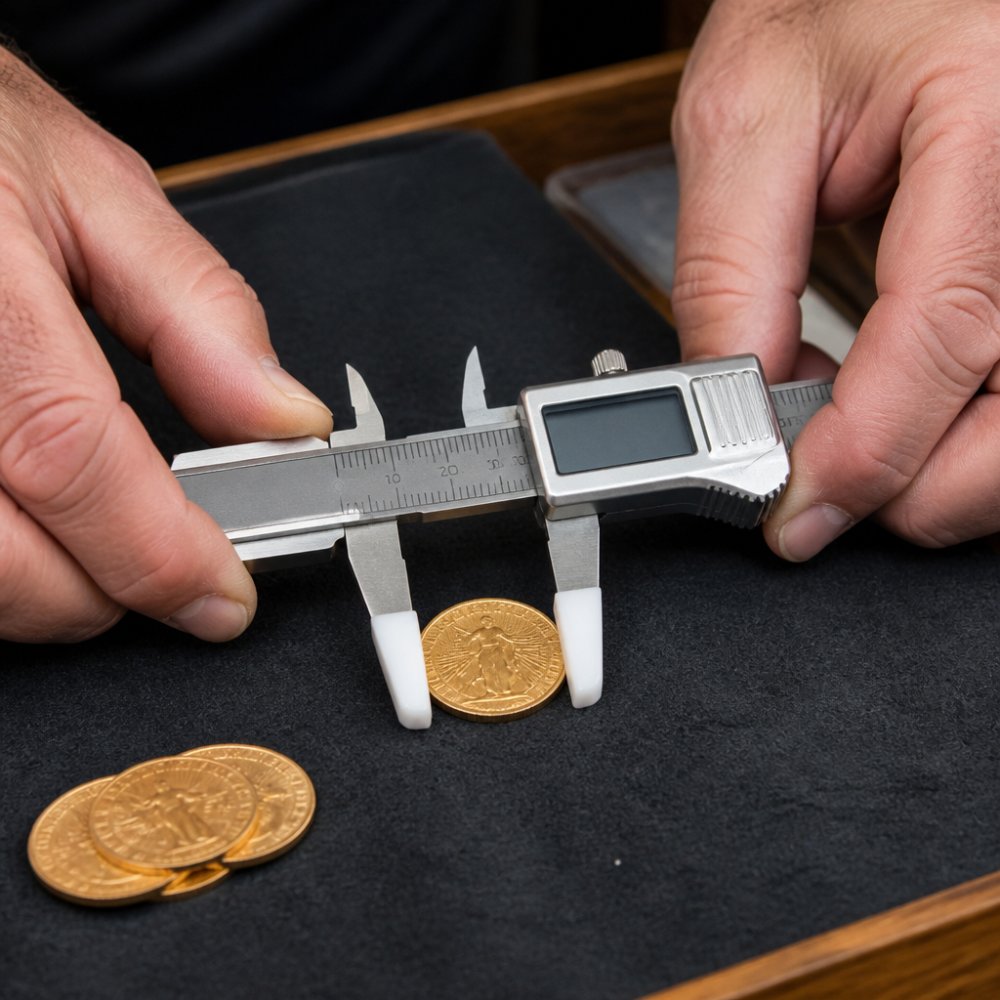
Standard hardened steel jaws can leave fine marks on a soft gold surface, especially on proof coins with delicate surface relief. Nylon-tipped or carbide-tipped jaws, or a thin strip of tape over the jaw faces, prevent that. The rule is simple: never let bare steel touch the face of a coin you care about.
How to Zero and Calibrate Your Calipers Before Measuring
Zeroing your calipers before every session is the single habit that prevents most bad readings. Close the jaws completely, confirm the display reads 0.00 mm, and press the zero button if it does not. Do this each time you sit down, not once a month.
For calibration, use a known reference. A certified gauge block or a coin with published standardized specifications works well. If your caliper reads a known 1.000-inch block as 0.998, note the offset and account for it. Repeatability matters as much as absolute accuracy: measure the same object five times and the readings should cluster tightly.
Step-by-Step: Measuring Coin Diameter and Thickness
The process takes under a minute once you build the habit, but the technique is not identical for every gold coin. Bullion coins and numismatic coins have different surface geometry, and where you place the jaws changes the reading. Work on a clean felt pad so a dropped coin lands softly.
The Basic Diameter and Thickness Routine
- Zero the calipers with jaws fully closed.
- Open the jaws wider than the coin and place the coin flat between them.
- Close the jaws until they just touch the coin's edge. Do not squeeze.
- Read the diameter from the display and record it.
- For thickness, grip the coin across its face, away from the rim, and close gently.
- Repeat each measurement three times and average the results.
Measuring Bullion Coins vs. Numismatic Coins
Bullion coins such as the American Gold Eagle and the Canadian Gold Maple Leaf are struck with a raised rim and, in the Eagle's case, a raised design that sits close to the rim. The widest point of the coin is the rim, so diameter should be taken across the rim, not across the relief. If you close the jaws on the raised design instead of the rim, you will read a smaller number and may wrongly conclude the coin is underweight in dimension.
Numismatic coins add a second complication: wear.
Thickness: Where to Place the Jaws
Thickness is the measurement most collectors get wrong. Placing the jaws on the raised design gives you the height of the relief, not the thickness of the planchet. Place the jaws on the flat field of the coin, between the rim and the design, and close gently. On a coin with a wire rim or a wide rim, the rim itself is the thickest point, so a rim measurement is the correct one for comparing against published thickness specs.
Recording Your Measurements
Write down diameter, thickness, and the date and mint mark together. A single number in isolation tells you little. The pattern across several coins of the same type is what reveals whether your technique is consistent and whether a suspect coin is genuinely out of tolerance.
Using Caliper Data to Identify Gold Coins and Spot Counterfeits
Caliper measurements are one leg of a three-part check: dimensions, weight, and visual inspection. A counterfeit detection routine that skips any of these will miss good fakes.
Here is how the parts compare:
| Check | What It Catches | Tool Needed |
|---|---|---|
| Diameter and thickness | Wrong-size fakes, plated base metal | Calipers |
| Weight | Wrong-density alloys, hollow strikes | Precision scale |
| Visual and surface relief | Poor detail, wrong die markers | Loupe or microscope |
Why Calipers Alone Are Not Enough
A caliper measures length. It cannot measure mass, and mass is where most modern fakes fail. Gold has a density of roughly 19.3 grams per cubic centimeter at room temperature. Common counterfeit alloys, brass, copper, tungsten, and gold-plated lead or zinc, have densities that range from about 7 to 19.25 g/cm³. Tungsten sits close to gold at about 19.25 g/cm³, which is why it is the alloy counterfeiters reach for when they want a coin that passes a weight check.
What Surface Relief Tells You That Dimensions Cannot
Calipers measure the outline of a coin, not its surface. A cast counterfeit made from a mold of a genuine coin will often match the genuine coin's diameter and thickness closely, because the mold was taken from a real coin. What the mold cannot reproduce cleanly is the sharpness of the relief.
A Practical Three-Part Routine
- Measure diameter across the rim and thickness on the flat field. Compare against published specs for the date and mint mark.
- Weigh the coin on a precision scale that reads to at least 0.01 gram. Compare against the published weight.
- Examine the high points and the field under a loupe. Look for soft relief, casting pits, or a grainy field.
If all three pass, the coin is very likely genuine. If any one fails, treat the coin as suspect until a second method confirms it. When caliper readings fall outside the published tolerance for a date and mint mark, that is a strong signal, but it is a signal to investigate further, not a verdict on its own.
Common Mistakes That Skew Coin Measurements
The biggest mistake is jaw pressure. Squeezing the jaws flexes the coin or the caliper and shaves real numbers off your reading. Let the jaws rest against the coin, not clamp it.
Other frequent errors:
- Measuring a tilted coin, so you read a chord instead of the true diameter.
- Forgetting to re-zero after switching units or dropping the tool.
- Reading a worn coin's high points instead of its widest edge.
- Using a dirty jaw face, which adds a false fraction of a millimeter.
Conclusion
Getting accurate coin dimensions comes down to the right caliper, a zeroed tool, and gentle technique. Treasure Coast Detectors offers expert guidance before and after purchase and curated bundles to help you find the right equipment. Get started with Treasure Coast Detectors and measure every coin with confidence.
Frequently Asked Questions
What are common mistakes when using calipers to measure gold coins?
The biggest mistakes are squeezing too hard (which compresses soft gold and skews readings), forgetting to zero the calipers first, and measuring a tilted coin instead of keeping it flat against the jaws. Dirty jaws and worn batteries also cause measurement error. Always zero before each session, use light jaw pressure, and take three readings to confirm repeatability before recording a final number.
How accurate are calipers for measuring coin dimensions?
A quality digital caliper for coin collecting typically offers 0.01 mm resolution and accuracy of plus or minus 0.02 mm, which is more than enough to detect counterfeit gold coins that are often off by 0.1 mm or more in diameter. For best results, verify calibration with a known reference like a certified gauge block, and compare your reading against published standardized specifications for that coin type.
Why is measuring the thickness of a gold coin important?
Thickness is one of the hardest dimensions for counterfeiters to fake because it interacts with diameter and weight to produce the correct density. A coin that matches the expected diameter but is too thick or too thin is a red flag. Measuring edge thickness with calipers, combined with a precision scale, gives you a weight-versus-dimension cross-check that catches many fakes.
Can calipers damage a gold coin?
Standard hardened steel jaws can leave fine scratches on soft gold, especially on proof surfaces. Use calipers with nylon or non-marring tips, or place a thin sheet of archival tissue between the jaw and the coin face. Apply only light jaw pressure and never slide the coin against the jaws. With those precautions, calipers are safe for routine numismatic measurement.
Leave a comment