

Choosing a Detector for Mineralized Soil: 2026 Guide
Table of Contents
- What Is Ground Mineralization and Why It Wrecks Depth
- Ground Balance Metal Detector Explained
- VLF vs PI Metal Detectors for Mineralization
- How to Stop Metal Detector False Signals in Tough Soil
- Choosing a Detector for Mineralized Soil: Key Criteria
- Best Mineralized Soil Detectors Worth Buying
- Maintenance for Detectors Used in Harsh Soil
- Conclusion
Last Updated: August 23, 2026
Choosing a detector for mineralized soil is one of the most misunderstood challenges in metal detecting. Hunters who dig endless trash targets, miss coins at depth, or face relentless false signals almost always have a mismatch between the detector's technology and the ground it's working in. Below, we'll walk through how mineralization wrecks performance, which technologies fight back, and how to calibrate your setup for tough soil conditions.
What Is Ground Mineralization and Why It Wrecks Depth
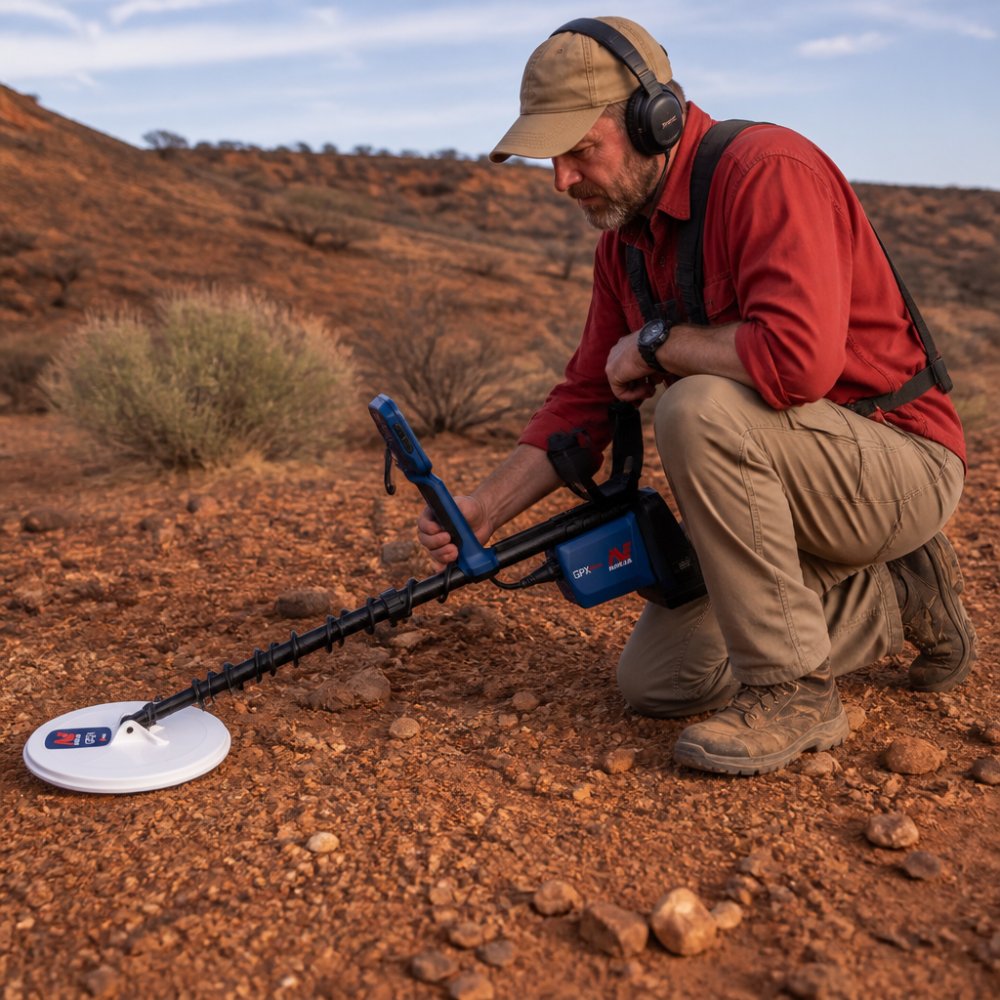
Ground mineralization is the presence of electrically or magnetically conductive minerals within the soil that interfere with a metal detector's electromagnetic field. The detector sends a signal into the ground and reads the return. Mineralized soil creates its own return signal, masking the signal from actual targets and causing lost depth, unstable threshold, and constant false signals. Severity depends on mineral type and concentration. Magnetite, red clay, and iron oxide are the biggest culprits (usgs.gov). Saltwater-saturated sand adds a different layer of conductivity. Hot rocks, individual stones with higher mineral content than surrounding soil, can trigger responses loud enough to sound like a silver coin.
Iron Mineralization and Hot Rocks
Iron mineralization is the most common performance killer across the American Southwest, Southeast, and any area with volcanic or glacially deposited soils. The ferrous content produces a ground phase reading that competes directly with low-conductivity targets like small gold nuggets or thin copper coins.
Hot rocks are stones whose mineral composition produces a stronger electromagnetic response than surrounding ground. Positive hot rocks respond like metal targets; negative hot rocks cause the threshold to drop out. Both produce false signals that exhaust a hunter's patience within minutes.
How to Tell If Your Soil Is Highly Mineralized
The fastest field test is to pump the search coil toward the ground while listening to the threshold tone. If the threshold rises as the coil approaches, the soil has positive mineralization. If it drops, you're dealing with negative or conductive ground. Significant threshold swings indicate a ground phase mismatch that needs correction. A systematic approach uses USGS soil survey maps, which document mineral composition by region.
Ground Balance Metal Detector Explained
Ground balance is the detector's mechanism for filtering out electromagnetic interference produced by mineralized soil, allowing it to focus on metallic targets. A properly ground-balanced detector "learns" the soil's background signal and subtracts it, restoring depth performance and signal stability. Without correct ground balance, the detector reads the soil itself as a target, producing constant chatter, destabilized threshold, and target signals buried under geological noise.
Manual Ground Balance vs. Automatic Ground Tracking
Manual ground balance requires the operator to set the ground phase value by pumping the coil over clean ground and adjusting until the threshold stabilizes. This takes more skill but gives precise control. Hunters working consistent soil benefit from locking in a manual setting.
Automatic ground tracking continuously samples the ground signal and adjusts the balance point in real time. This is valuable in variable soil where mineralization shifts between patches of red clay, sand, and decomposed granite. The trade-off is that aggressive automatic ground tracking can occasionally "track out" a shallow, low-conductivity target like a small gold piece.
| Feature | Manual Ground Balance | Automatic Ground Tracking |
|---|---|---|
| Best for | Consistent, uniform soil | Variable or shifting ground conditions |
| Operator skill required | Higher | Lower |
| Risk of masking targets | Low | Moderate (shallow, low-conductivity) |
| Response to hot rocks | Requires manual adjustment | Adapts continuously |
| Typical use case | Gold prospecting, stable sites | Relic hunting, changing terrain |
Most out-of-the-box settings assume average, low-mineralization soil. Leaving a detector on factory ground balance settings and wondering why it performs poorly is a common mistake.
VLF vs PI Metal Detectors for Mineralization
The technology choice between VLF and PI is the single most important hardware decision for detecting in tough ground.
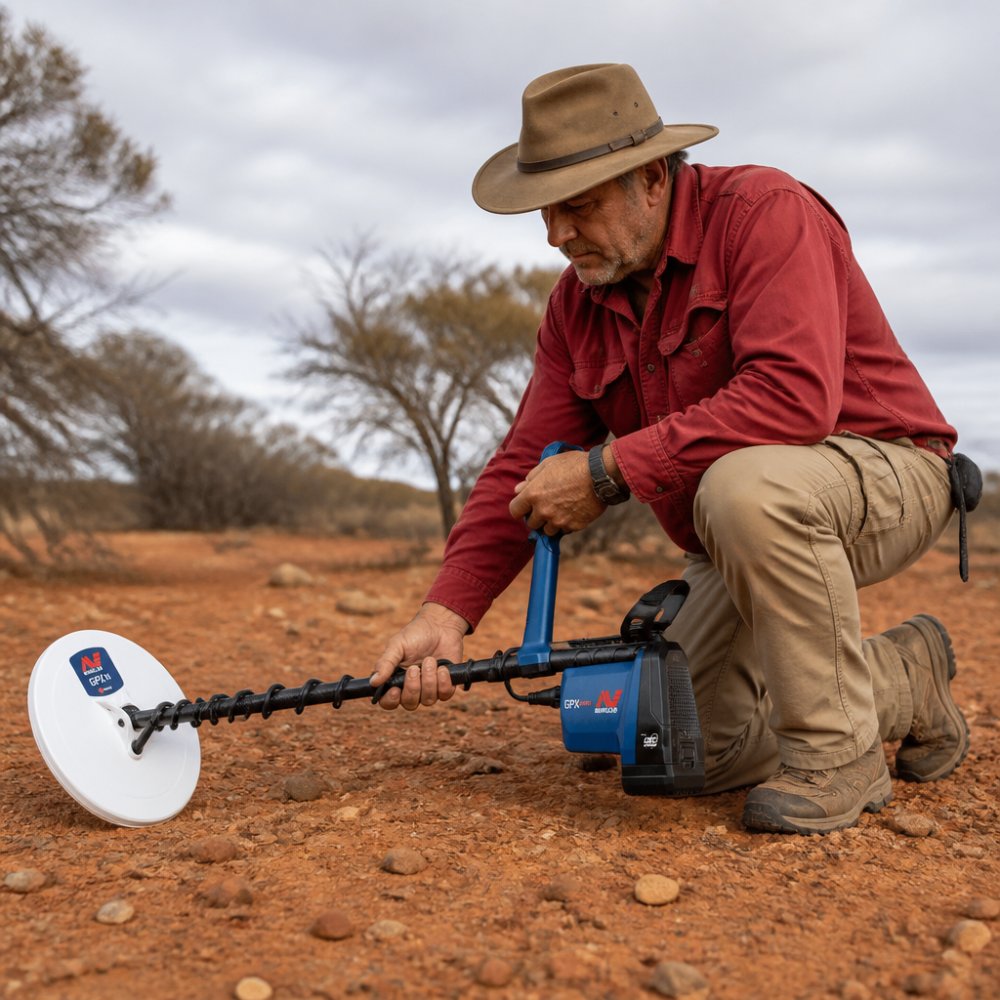
Very Low Frequency (VLF) detectors transmit a continuous sine wave at a fixed frequency, typically between 3 kHz and 100 kHz, and read phase shifts in the return signal to identify target conductivity. They offer excellent target identification and discrimination. The weakness is that VLF technology is inherently susceptible to ground mineralization.
Pulse Induction (PI) detectors transmit rapid pulses and measure the decay time of the return signal. Because PI technology doesn't rely on phase analysis, it's largely immune to ground mineralization and saltwater interference. The trade-off is reduced target identification capability; most PI detectors provide less discrimination, making target separation harder in iron-littered sites.
Multi-frequency technology sits between the two. Detectors that transmit and receive across multiple frequencies simultaneously can optimize ground balance across a wider range of soil conditions and often outperform single-frequency VLF in moderately mineralized ground without sacrificing discrimination advantages.
When VLF Wins
VLF detectors, particularly multi-frequency VLF models, are the better choice when target separation and discrimination matter as much as raw depth. Coin shooting in a mineralized park, relic hunting in a Civil War site loaded with iron trash, or beach hunting in wet sand all favor VLF. Single-frequency VLF at higher frequencies (above 14 kHz) also performs well on small, low-conductivity targets in mildly mineralized ground.
When Pulse Induction Wins
PI technology wins when the ground is so severely mineralized that VLF detectors become unstable regardless of ground balance adjustments. Deep gold prospecting in highly mineralized soils, saltwater beach hunting, and detecting in volcanic or heavily ferrous ground all favor PI. The limitation is worth repeating: PI machines generally provide less target identification detail. finding raw gold.
How to Stop Metal Detector False Signals in Tough Soil
False signals are the most frustrating part of detecting in mineralized ground. The first step is distinguishing between a ground noise false signal and a genuine target signal. Ground noise tends to be directional: it appears when the coil passes over a specific patch from one direction but not consistently from multiple angles. A real target signal is repeatable from multiple sweep directions.
Troubleshooting False Signals vs. Real Targets
False signal sources and fixes:
- Ground mineralization noise: Re-ground-balance over the problem area. If the false signal disappears after re-balancing, the soil phase shifted. Automatic ground tracking helps prevent this.
- Hot rocks: Slow the sweep speed and listen for a double-blip or broken signal. A genuine coin produces a clean, repeatable tone.
- Electromagnetic interference (EMI): Power lines, other detectors nearby, and some soil conditions generate EMI that produces random chattering. Reducing sensitivity, switching operating frequency, or using noise cancellation functions resolves most EMI issues.
- Coil size mismatch: Large coils cover more ground but are more susceptible to mineralization effects. In highly mineralized soil, a smaller coil improves signal stability and target separation.
The threshold setting also matters. A threshold set too high amplifies ground noise alongside target signals. Lowering the threshold reduces false signals but can also reduce depth.
Choosing a Detector for Mineralized Soil: Key Criteria
The right mineralized soil detector depends on four variables: the severity of mineralization, the target type, the site's iron trash density, and the operator's experience level.
Core selection criteria:
- Ground balance capability: Manual, automatic, or both? More mineralized ground favors detectors with both options.
- Operating frequency: Higher frequencies find small, low-conductivity targets; lower frequencies penetrate deeper for large, high-conductivity targets.
- Multi-frequency capability: Single-frequency VLF struggles in variable soil. Multi-frequency handles transitions better.
- Discrimination and target separation: Iron-heavy sites demand strong discrimination.
- Coil options: Smaller coils for high-mineralization, high-trash sites. Larger coils for depth in cleaner ground.
- Build quality: Harsh soil conditions often mean harsh environments. Weather resistance and coil durability matter.
Regional Soil Maps and Geological Indicators
Soil type varies dramatically by region. The Web Soil Survey from USDA provides free, map-based soil composition data down to the field level. Before hunting a new site, checking the parent material, drainage class, and iron content gives a realistic preview of ground balance challenges.
Key regional patterns include the Southeast's heavy red clay and laterite soils with high iron oxide content, the Southwest's caliche and volcanic basalt with magnetite-bearing soils (among the most challenging for VLF detectors), the Pacific Northwest's variable coastal saltwater conductivity and inland volcanic soils, and the Midwest's generally lower mineralization with localized glacial iron-bearing pockets.
Best Mineralized Soil Detectors Worth Buying
The detectors that perform in tough ground don't fight the soil, they read it. Here are the options that consistently deliver in high-mineralization conditions, available through Treasure Coast Detectors.
Minelab GPX 6000 is the benchmark for gold prospecting in severe mineralization. Powered by GeoSense-PI technology, it analyzes ground signals at exceptional speed and adjusts continuously, handling iron-mineralized, salt-affected ground that disables most VLF detectors. Available at Treasure Coast Detectors for $6,999.00.

Minelab GPZ 7000 uses ZVT technology with a Super-D coil, delivering unparalleled depth in mineralized ground. The precision ground balance system handles variable soil phases that challenge conventional PI machines. Priced at $9,499.00.
Minelab SDC 2300 brings PI performance in a compact, folding package. Its Multi Period Fast technology handles highly mineralized and salt-affected ground with sensitivity that surprises hunters used to VLF machines. At $3,699.00, it's the most accessible entry point into PI-level performance for tough soil.
Nokta Makro Gold Finder 2000 takes a different approach: a fixed 61 kHz high-frequency VLF optimized for gold fields, with simplified ground balancing that removes calibration complexity. Available at $543.15.
For pinpointing targets once you've got a signal, the DetectorPro Land or Sea Waterproof Pinpointer uses pulse circuitry that performs reliably in mineralized dirt and saltwater, backed by a 2-year warranty. At $109.95, it's a practical companion for any of the detectors above.
| Detector | Technology | Best Soil Condition | Price |
|---|---|---|---|
| Minelab GPX 6000 | GeoSense-PI | Severe mineralization, gold prospecting | $6,999.00 |
| Minelab GPZ 7000 | ZVT | Extreme depth, variable ground | $9,499.00 |
| Minelab SDC 2300 | Multi Period Fast PI | High mineralization, compact use | $3,699.00 |
| Nokta Gold Finder 2000 | 61 kHz VLF | Gold fields, moderate mineralization | $543.15 |
Maintenance for Detectors Used in Harsh Soil
Harsh soil doesn't just challenge performance, it accelerates wear. Iron-rich clay, abrasive sand, and moisture-laden ground all work against the detector's physical components over time.
Coil care is the priority. After every session in abrasive or wet soil, rinse the coil with fresh water and inspect the coil cover for cracks. A cracked coil cover allows abrasive particles to reach the coil's winding, causing intermittent false signals.
Connector and cable inspection should happen monthly for hunters who detect regularly in mineralized ground. Clean connectors with a dry brush and inspect cable insulation for abrasion near the coil junction.
Shaft and control housing need attention after wet-soil sessions. Dry the housing thoroughly and check O-ring seals on waterproof models. Store detectors with the coil disconnected when not in use for extended periods to prevent slow oxidation at the connector.
Highly mineralized soil doesn't have to end a hunt before it starts, but it does require the right tool and the right setup. The detectors that win in tough ground combine capable ground balance systems, appropriate technology for the soil type, and build quality that holds up to the conditions. Treasure Coast Detectors carries the full Minelab lineup, including the GPX 6000, GPZ 7000, and SDC 2300, along with Nokta and other top brands, with expert guidance to match the right machine to your specific ground conditions. Browse the full selection and get started with a detector built for the soil you're actually hunting.

Frequently Asked Questions
What is ground mineralization in metal detecting?
Ground mineralization refers to the concentration of conductive or ferrous minerals in soil, such as iron oxides, magnetite, and salt. These minerals generate their own electromagnetic field that interferes with a detector's signal, causing false signals, reduced detecting depth, and unstable threshold readings. Highly mineralized ground is one of the biggest challenges in metal detecting, particularly in areas with red clay, black sand, or volcanic soil. Proper ground balance settings are the primary tool for managing this interference.
How do I know if my soil is highly mineralized?
The clearest signs are constant false signals, a chattering threshold, and dramatically reduced depth compared to air tests. You can also pump the coil up and down a few inches above the ground: if the detector responds loudly, mineralization is high. Checking USGS geological survey maps for your region is a reliable way to identify iron-rich or volcanic formations before you dig. Black sand beaches and areas with red laterite soil are almost always high-mineralization environments.
Which metal detector technology is best for mineralized soil?
Pulse Induction (PI) technology generally outperforms Very Low Frequency (VLF) detectors in severely mineralized ground. PI detectors ignore ground minerals more effectively, maintaining depth performance where VLF machines struggle. However, PI detectors offer limited discrimination, meaning you dig more trash. Multi-frequency VLF detectors are a strong middle ground for moderate mineralization, balancing depth, target identification, and signal stability. Your soil's specific ferrous content and your target type should drive the decision.
How does ground balance help in mineralized soil?
Ground balance cancels out the electromagnetic response of soil minerals so the detector only reacts to metal targets. Without it, the ground itself reads as a target, flooding you with false signals and cutting detecting depth significantly. Manual ground balance lets you set the ground phase precisely for your location, while automatic ground tracking adjusts continuously as soil conditions change. For prospecting in variable terrain, automatic ground tracking is particularly useful since mineralization levels can shift within a single field.
Can metal detectors work in black sand?
Yes, but standard VLF detectors struggle badly in black sand because it contains magnetite, a highly conductive mineral that saturates the detector's signal. PI detectors handle black sand far better, which is why they dominate gold prospecting in regions with heavy black sand concentrations. Some advanced multi-frequency VLF machines also perform adequately in black sand with careful sensitivity adjustment and manual ground balance. Reducing coil sweep speed and lowering sensitivity are the first practical steps to improve performance.
What are 'hot rocks' and how do they affect detection?
Hot rocks are individual stones with a higher or lower mineral concentration than the surrounding soil. When a coil passes over them, they produce a sharp signal that mimics a metal target, triggering false digs. Highly ferrous hot rocks give a positive signal; conductive hot rocks can give a negative response. Detectors with good ground phase discrimination can often identify hot rocks by their signal characteristics. Adjusting the ground balance slightly and listening for a hollow or broken signal tone helps distinguish hot rocks from real targets.
This article was written using GrandRanker
Leave a comment