

Best Digital Scales for Weighing Gold Coins (2026 Guide)
Table of Contents
- Why Coin Collectors Need a Precision Scale
- Key Features to Compare in Digital Scales for Gold
- Weighing Gold Coins in Troy Ounces vs Grams
- How to Identify Gold Coins by Weight and Dimensions
- Digital Scale Calibration Guide for Consistent Accuracy
- Avoiding Common Weighing Mistakes
- Final Recommendations for Your Gold Coin Scale
- Frequently Asked Questions
Last Updated: September 8, 2026
Why Coin Collectors Need a Precision Scale
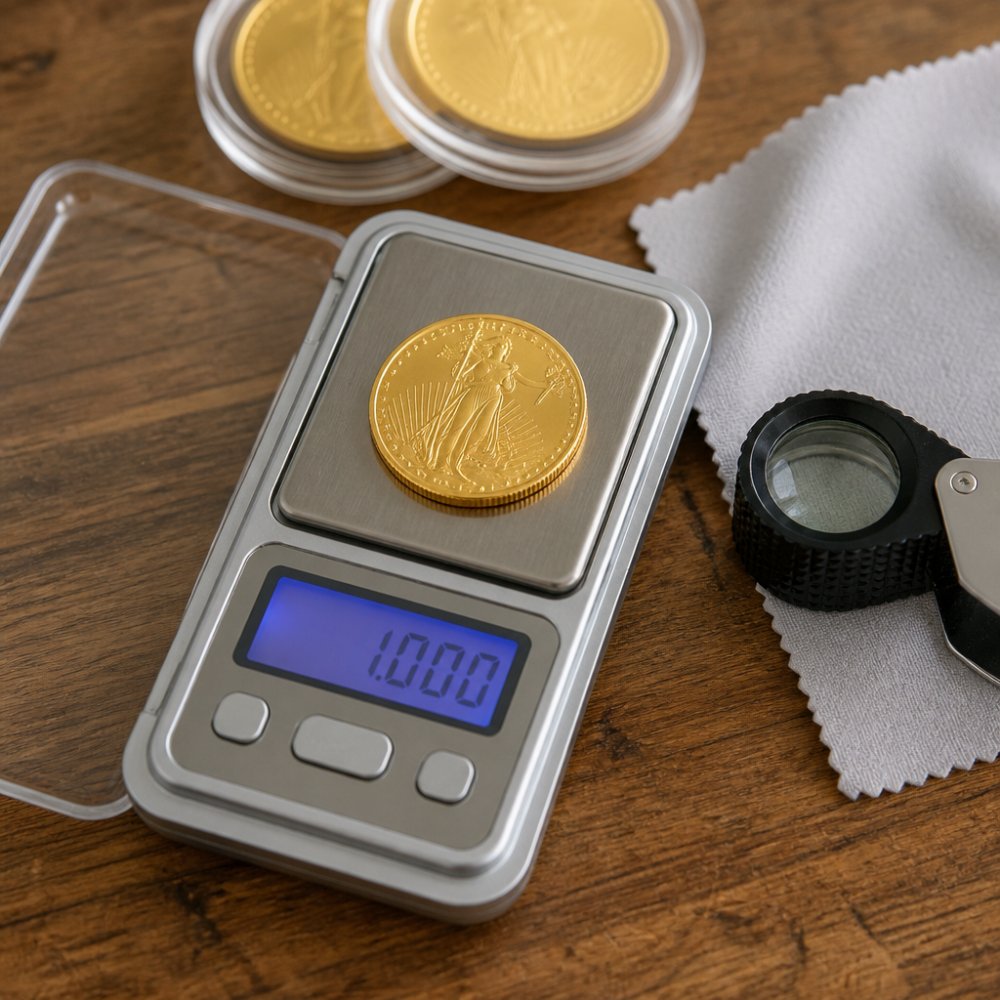
A digital scale for weighing gold coins is the single most important tool for verifying authenticity, determining melt value, and documenting your collection.
At Treasure Coast Detectors, we provide expert guidance to hobbyists who unearth coins and immediately wonder what they have found. A precise weight measurement is a fast way to begin answering that question.
The gold coin market attracts sophisticated counterfeits, many struck with correct dimensions but the wrong metal composition. A precision scale exposes these fakes instantly. Below, we'll show you exactly how to choose the best digital scales for weighing gold coins and what features actually matter.
Key Features to Compare in Digital Scales for Gold
The best digital scales for weighing gold coins share a core set of specifications, but the differences between a $20 pocket scale and a serious laboratory instrument matter enormously.
Readability and resolution come first, but know what the number really means. Readability is the smallest increment the scale can display, and resolution is the internal precision that supports it. For gold coins, you need a readability of at least 0.01 grams, and ideally 0.001 grams for bullion verification. A scale that only reads to 0.1 grams cannot reliably detect the weight variances that separate authentic coins from counterfeits. According to NGC's guidance on coin authentication, verifying weight against official mint specifications is a standard first step in authentication. But a 0.001-gram scale is not automatically better for coins: higher resolution often means a smaller weighing platform and slower stabilization time, because the load cell is optimized for tiny lab samples, not a 34-gram coin. For most U.S. gold coins, 0.01-gram readability is sufficient; 0.001 grams only matters if you weigh fractional gold pieces under 2 grams or want to detect plating thickness differences on modern bullion.
Weighing capacity is the second consideration, and the trade-off is real. Most individual gold coins weigh between 3 and 34 grams. A 100-gram capacity covers every U.S. gold coin ever minted. If you plan to weigh multiple coins together or check small bars, look for 200 to 500 grams. Higher capacity often means lower resolution at the same price point. If you only weigh coins, 100 grams is the sweet spot; if you also weigh scrap jewelry, step up to 200 grams but verify the readability holds.
The weighing platform and sensor quality dictate long-term reliability, and this is where cheap scales fail. A stainless steel platform resists corrosion and cleans easily. The load cell beneath it determines repeatability, the scale's ability to show the same weight for the same object across multiple measurements. In cheap scales, the strain gauge is often glued to an aluminum beam with inconsistent adhesive; in quality scales, it is bonded to a precision-machined beam. You cannot see this in a product photo, but you can test it: weigh the same coin five times. If readings vary by more than one readability increment, the load cell is not repeatable enough for coin verification.
Portability matters for the detector crowd, but weigh the convenience against the sensor. If you weigh finds in the field, a pocket scale with a protective case and auto-off function suits you best. If you weigh at a desk, a tabletop model with a larger platform and backlit LCD is more comfortable. Consider USB charging versus batteries, and a tare function for weighing coins in slabs or capsules. Pocket scales are more exposed to shock, dropping one even once can shift the load cell's zero point. If you need both, buy two scales: a rugged pocket unit for field screening and a stable tabletop unit for final verification.
| Feature | What to Look For | Why It Matters | Trade-Off to Watch |
|---|---|---|---|
| Resolution | 0.01 g minimum, 0.001 g ideal | Detects counterfeit weight variances | Higher resolution often means smaller platform and slower stabilization |
| Capacity | 100 g to 500 g | Covers all U.S. gold coins | Higher capacity can reduce low-end repeatability |
| Platform | Stainless steel | Resists corrosion, easy to clean | Smaller platforms may not fit coins in capsules |
| Tare Function | Yes | Weigh coins in slabs or capsules | Tare range is limited by capacity; check the spec |
| Power | USB or battery | Matches your weighing location | Battery drain causes drift; USB scales need a stable power source |
| Stabilization Time | Under 3 seconds | Faster workflow | Faster is not always better; verify the reading settles |
Weighing Gold Coins in Troy Ounces vs Grams
Precious metals are weighed in troy ounces, not the avoirdupois ounces used for everyday items. A troy ounce equals 31.1035 grams, while a standard ounce equals 28.35 grams. Confusing the two can misvalue a coin by nearly ten percent.
Most digital scales default to grams, which is the best unit for verification because official mint specifications are published in grams. The U.S. Mint lists the American Gold Eagle at 31.1 grams, and the Gold Buffalo at the same weight.
Troy ounces become relevant when you calculate melt value. A scale that offers a troy ounce mode is convenient, but you can always convert manually. The official conversion is established by international agreement and documented by the U.S. Mint's specifications for gold bullion coins. For everyday weighing, learn the gram weights of the coins in your collection and use grams as your primary unit.
Grains are another unit you will encounter, primarily in older reference books and for very small gold pieces. One gram equals 15.432 grains. Unless you work with antique fractional coins, you can safely ignore grains for most modern bullion verification.
How to Identify Gold Coins by Weight and Dimensions
Weight alone rarely confirms a coin's authenticity, but it is the fastest screening tool available. The process starts with knowing the official specifications for the coin you are examining.
Step 1: Establish the baseline. Look up the official weight and diameter for your specific coin. The U.S. Mint coin specifications database publishes these figures for every coin it produces. For historic coins, consult a reputable numismatic reference.
Step 2: Weigh the coin. Place it gently in the center of the weighing platform. Record the stable reading. A genuine coin will fall within a small tolerance of the official weight, typically plus or minus a fraction of a gram depending on the minting era and wear.
Step 3: Measure the diameter. Use a caliper for this, not a ruler. Counterfeiters often get the diameter right but the thickness wrong, which changes the weight. Comparing both measurements against official specs catches most fakes.
Step 4: Cross-check with dimensions. If the weight is correct but the diameter is off, you likely have a coin with the wrong metal density. If both are correct, the coin deserves closer inspection for edge details, strike quality, and surface characteristics.
Digital Scale Calibration Guide for Consistent Accuracy
Calibration is the process of teaching your scale what a known weight measures like, and it is the difference between a useful tool and a decorative paperweight. Most digital scales drift over time, and temperature changes, battery levels, and physical shocks all affect the load cell's accuracy. But the step most guides skip, and the one that separates a reliable reading from a confident mistake, is verifying that your calibration weight is actually accurate. Here is the full protocol, including how to test your scale without spending money on certified weights.
Calibration weight verification comes first, and this is where most hobbyists go wrong. Your scale likely shipped with a calibration weight, but its accuracy is rarely certified. The included weight is often a stamped metal disc with a nominal value, not a precision standard. Before you trust it, verify it against a known reference. The most reliable method is to order a certified calibration weight from a reputable supplier, such as those traceable to NIST's mass calibration program. These weights come with a certificate of accuracy and are manufactured to exact tolerances. A certified 50-gram weight, for example, is accurate to within ±0.5 milligrams, which is far tighter than your scale's 0.01-gram readability. But if you do not want to spend $30 to $50 on a certified weight, you can use a coin whose weight you have confirmed through professional authentication. A genuine American Gold Eagle, authenticated by a grading service, has a known weight of 31.1 grams. Weigh it on a scale you trust, record the reading, and use that coin as your reference. The risk is that your reference coin has wear or residue, so handle it with cotton gloves and store it in a sealed capsule.
The calibration process is straightforward, but the environment matters more than the button sequence. Place the scale on a flat, stable surface away from drafts and vibration. Turn it on and allow it to warm up for a minute; the load cell's electrical resistance changes as it reaches operating temperature, and calibrating a cold scale locks in an error. Press the calibration mode button (often labeled CAL), place the calibration weight gently, wait for the reading to stabilize, and the scale will confirm completion.
How often should you calibrate? A reasonable routine is to calibrate before any critical weighing session, or at minimum once a month with regular use. If you drop the scale or move it between locations, recalibrate immediately. Environmental interference is a real concern. NIST's handbook on weighing practices emphasizes that temperature, humidity, and air currents all affect precision measurements, so keep your scale away from HVAC vents and direct sunlight. A common pattern is that a scale drifts most in the first 30 minutes after being moved from a cold car to a warm room. Let the scale acclimate for at least 15 minutes before calibrating.
Here is a household test to verify your scale without a certified weight. A modern U.S. dime weighs 2.268 grams, a nickel weighs 5.000 grams, and a quarter weighs 5.670 grams. These are minted to tight tolerances and are useful for a quick sanity check. Place a nickel on your scale. If it reads between 4.98 and 5.02 grams, your scale is likely within acceptable range; if it reads 5.10 grams, it has drifted and needs recalibration. This test does not replace certified weights, but it catches gross errors before you trust a reading on a valuable coin.
Sensor degradation is the long-term risk that calibration cannot fix. Load cells are mechanical components that wear with use and age. The strain gauge develops micro-cracks from repeated flexing, changing its electrical response. If you notice increasing drift or inconsistent readings after recalibration, replace the scale. A quality scale can last 5 to 10 years with regular use; a cheap scale may drift within months.
Avoiding Common Weighing Mistakes
Even with the best digital scales for weighing gold coins, small errors in technique produce misleading results. The most frequent mistake is weighing coins on a dusty or uneven surface. Always use the weighing platform as intended, and ensure the scale sits on a perfectly level table.
Air currents and static electricity are silent saboteurs. A scale reading to 0.01 grams responds to a breath of air across the platform. Close nearby windows, turn off fans, and avoid placing the scale near vents. Static charge on plastic coin holders can also create false readings; an anti-static brush or handling the coin with cotton gloves often resolves this.
Battery condition affects accuracy. As batteries drain, voltage to the load cell drops and readings drift. If your scale behaves erratically, replace the batteries before questioning the scale itself. USB charging eliminates this variable but requires keeping the battery healthy during long storage periods.
The auto-off function is a double-edged sword. It preserves battery life but can interrupt a weighing session just as you place a coin. Learn your scale's auto-off delay and get comfortable restarting it quickly. Some scales allow you to disable auto-off entirely for extended sessions.
Final Recommendations for Your Gold Coin Scale
The ideal setup depends on how you collect and where you weigh. For most hobbyists, a pocket-sized scale with 0.01-gram resolution and a 100-gram capacity handles every gold coin in a typical collection. It fits in a gear bag alongside your metal detector and weighs finds on the spot.
For serious numismatists and bullion investors, a tabletop model with 0.001-gram resolution and a 200-gram capacity provides the precision needed to verify modern bullion against mint specifications. The larger platform accommodates coins in protective capsules, and the higher resolution catches weight variances that cheaper scales miss.
Whatever you choose, budget for a certified calibration weight and a protective case. These accessories cost little compared to the value of the coins you are protecting, and they extend the useful life of your scale considerably.
At Treasure Coast Detectors, we provide expert guidance to collectors for identifying and preserving their finds. A precision scale belongs in every serious collector's kit, right next to the loupe and the reference guide.
Frequently Asked Questions
What is the most accurate scale for weighing gold coins?
For weighing gold coins, accuracy depends on resolution and calibration. Look for a digital scale with 0.01 gram (or 0.001 troy ounce) readability. A scale with this precision can detect the small weight differences that matter for authentication. Equally important is a scale that accepts a certified calibration weight, so you can verify its accuracy before each use. Scales marketed as jewelry or precious metal scales often meet these specifications, but always check the stated resolution and capacity to ensure they suit your coin collection.
Do I need a calibration weight for my gold scale?
Yes. A calibration weight is essential for maintaining accuracy, especially when weighing precious metals where small errors are costly. Over time and with temperature changes, a scale's sensor can drift. Using a certified calibration weight, ideally one that matches a common weight in your collection, lets you run the scale's calibration mode to restore accuracy. For best results, calibrate your scale before each weighing session and store it in a stable environment. This practice is a core part of any reliable digital scale calibration routine.
What is the difference between a grain scale and a gram scale for gold?
A grain scale measures in grains, a unit often used for gunpowder and jewelry, while a gram scale measures in grams or troy ounces, which are the standard units for gold bullion and coins. While many modern digital scales offer both units, you should prioritize a scale that reads in troy ounces and grams. The troy ounce (31.1035 grams) is the industry standard for precious metals, so using a scale without this unit forces you to convert, which introduces potential errors when weighing gold coins.
Can a digital scale verify if a gold coin is counterfeit?
Weighing a coin is a strong first step in counterfeit detection, but it is not conclusive on its own. Compare the coin's weight against the official specifications for that issue; a significant discrepancy indicates a fake. However, counterfeiters can use proper metals to match weight. For a more reliable identification, combine weight data with dimensional checks using calipers and a visual inspection for details, edge lettering, and magnetic properties. A digital scale helps flag suspicious coins, but it is one tool in a broader verification process.
Choosing the best digital scales for weighing gold coins comes down to resolution, capacity, and calibration discipline. The right scale protects you from counterfeits and gives you confidence in every valuation. Treasure Coast Detectors carries the equipment and expertise to support your collection, from detectors to the accessories that complete your setup. Explore our selection and get started with the tools that make every find count.
Leave a comment