

How to Find a Lost Engagement Ring on the Beach (2026 Guide)
Table of Contents
- Act Fast: Immediate Steps After Losing a Ring on the Beach
- How to Mark the Location and Set Up a Search Grid
- Reading Tide Charts for a Lost Engagement Ring Search
- Best Metal Detectors for Beach Hunting and Sand Sifting Tools
- Hiring a Professional Ring Finder vs. DIY Recovery
- What to Do If the Ring Is in the Water or Surf Zone
- Documentation, Insurance, and Reporting a Lost Engagement Ring
- Conclusion
- Frequently Asked Questions
Last Updated: September 12, 2026
Act Fast: Immediate Steps After Losing a Ring on the Beach
The first hour after losing an engagement ring on the beach matters more than any other. Sand moves fast, the tide does not wait, and every person who walks past your spot risks kicking the ring deeper or further away. The good news: most beach recoveries succeed when the search starts immediately, before the shoreline changes.
Here is what to do in the first ten minutes, in order:
- Stop moving. Freeze exactly where you are standing. The ring is almost certainly within a few steps of where you noticed it was gone.
- Drop a marker. Push an umbrella, cooler, shoe, or towel into the sand at your current position. This becomes your anchor point.
- Retrace your last few minutes. Walk back along your exact path slowly, eyes down, hands empty. Do not kick the sand.
- Note the tide state. Check whether the water is coming in or going out. An outgoing tide gives you time; an incoming tide means you are racing it.
- Call for help early. A second set of eyes doubles your coverage, and a friend can guard the marked spot while you fetch equipment.
At Treasure Coast Detectors, we hear from beachgoers every season who found their ring simply because they stopped, marked the spot, and searched methodically instead of panicking. Panic scatters the search area. Discipline keeps it tight.
How to Mark the Location and Set Up a Search Grid
Marking the location correctly is the difference between a 20-minute recovery and a three-hour one. Use two fixed reference points, not one, so you can triangulate the spot from any angle.
Good landmark choices on a beach include:
- A lifeguard tower or beach patrol station
- A jetty, rock outcrop, or pier piling
- A dune fence post or access path marker
- A distinctive building or boardwalk entrance behind the beach
If you have a phone, drop a pin with GPS coordinates at the spot where you think the ring was lost. Note the time. This gives you a reference if you need to return after the tide changes.
How to Grid Search a Beach for Jewelry
Grid searching is the practice of dividing a search area into a defined pattern of lanes and walking each lane in a straight line, then repeating the pattern perpendicular to the first pass. It is the single most reliable method for covering ground without missing a target.
Set up your grid like this:
- Define a rectangle around the marker, roughly 10 meters by 10 meters (about 30 feet by 30 feet) to start.
- Walk parallel lanes spaced about 1 meter (3 feet) apart, sweeping slowly.
- Turn at the end of each lane and walk back on the next lane.
- Once the full rectangle is covered, walk the same area again at 90 degrees to your first pass.
- Expand the rectangle by 5 meters (about 16 feet) in every direction and repeat if the first pass comes up empty.
| Grid Step | Distance Between Lanes | Best For |
|---|---|---|
| Tight grid | 0.5 meter (20 inches) | Small rings, recent drops |
| Standard grid | 1 meter (3 feet) | General beach search |
| Wide grid | 2 meters (6 feet) | Large items, fast coverage |
A common mistake is searching in circles. Circular patterns leave gaps at the edges, and gaps are exactly where rings hide. Keep your lanes straight and your pace slow.
Reading Tide Charts for a Lost Engagement Ring Search
Tide charts are the most underused tool in beach recovery, and they change everything about how you plan a search. A tide chart tells you the exact times of high tide and low tide for your stretch of coastline, usually published days or weeks in advance by the National Oceanic and Atmospheric Administration (NOAA).
NOAA tide predictions and coastal charts
Why this matters: a ring lost in dry sand above the high tide line stays put. A ring lost in the wet sand or surf zone gets moved, sometimes dramatically, by every wave cycle. If your ring was lost near the water, the outgoing tide is your best friend. The receding water exposes ground that was underwater minutes earlier, and the ring may be sitting right on the newly exposed surface.
Plan your search around low tide. Arrive 30 to 60 minutes before the low tide mark, work the wet sand and the tide line first, then move up the beach as the water returns. If you must search during high tide, focus entirely on the dry sand above the recent high-water mark.
Best Metal Detectors for Beach Hunting and Sand Sifting Tools
The right equipment decides whether you recover the ring or spend the afternoon digging bottle caps. For wet sand and saltwater, you need a detector built for mineralized ground, because standard detectors lose depth and produce constant false signals when salt and water interfere with the coil.
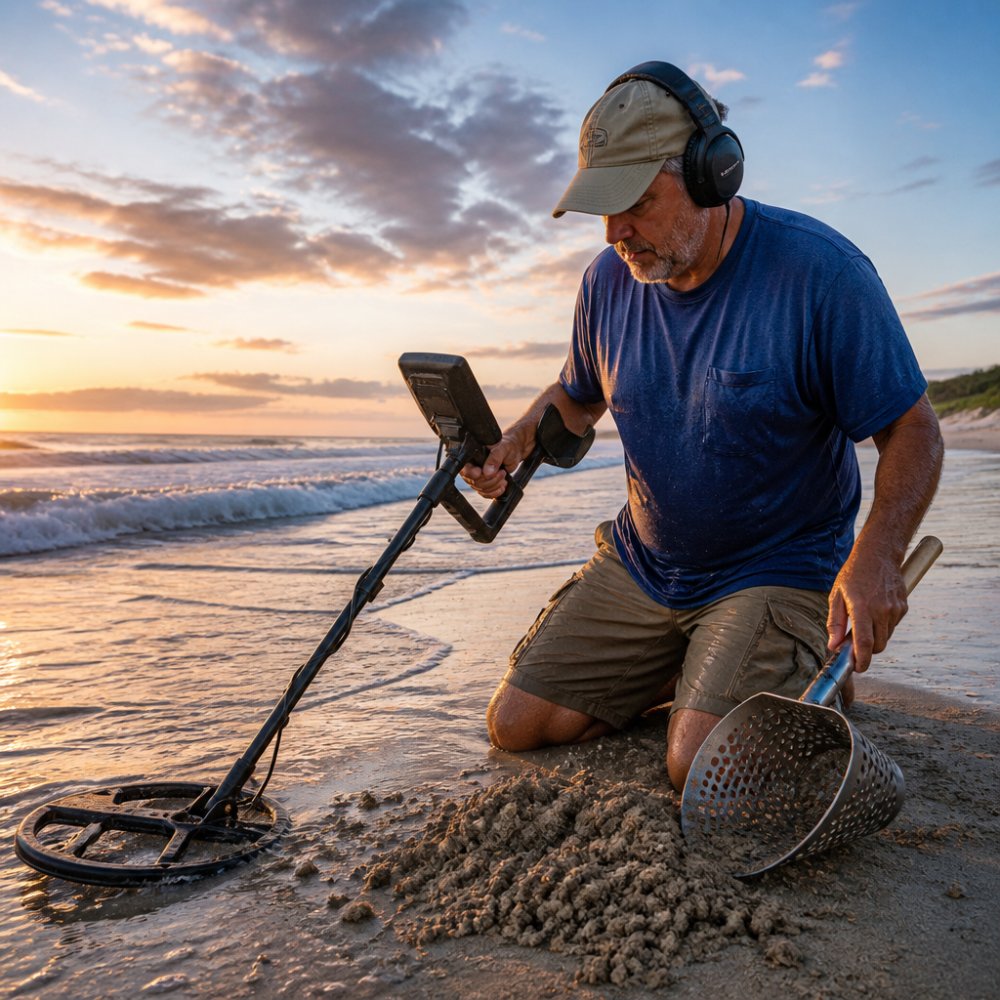
For serious beach recovery, the Minelab Manticore Multi-IQ+ Waterproof Metal Detector is the strongest all-around choice. Its multi-frequency technology handles saltwater and mineralized sand without the false signals that plague single-frequency machines, and it is fully waterproof for surf-zone work. At $1,499.00, it sits at the higher end, but it is the detector our customers reach for when the target is small, valuable, and possibly underwater.

If the ring is likely submerged in the surf zone or deeper, the Minelab Excalibur II Metal Detector is purpose-built for the job. It is waterproof to 200 feet (66 meters) and uses BBS multi-frequency technology tuned for saltwater and harsh underwater conditions. At $1,699.00, it is the tool for divers and dedicated underwater recovery.

On the digging side, a proper sand scoop saves your hands and your time. The T-Rex Sand Scoops come in 6-inch, 8-inch, and 9.5-inch honeycomb designs built from heavy steel, and they cut through wet sand without bending. The Motley Beach Scoop with 46" Steel Handle is a lighter option at $189.99, made from two-millimeter stainless steel with a large-capacity basket for sifting efficiently.

| Tool | Price | Best For |
|---|---|---|
| Minelab Manticore | $1,499.00 | All-around beach and surf recovery |
| Minelab Excalibur II | $1,699.00 | Underwater and deep surf-zone searching |
| T-Rex Sand Scoops | $239.00 | Heavy-duty wet sand digging |
| Motley Beach Scoop | $189.99 | Lighter beachcombing and sifting |
What most guides miss is that the detector matters less than the coil control. A slow, overlapping sweep with a mid-range machine beats a fast, sloppy sweep with a top-tier one every time. Depth sensitivity comes from patience, not price.
Hiring a Professional Ring Finder vs. DIY Recovery
A professional ring finder is a volunteer or paid detectorist who specializes in recovering lost jewelry, often responding within hours of a call. Many operate free of charge, accepting only a thank-you or a voluntary reward, and they bring years of beach experience plus equipment tuned for exactly this task.
The Ring Finders directory of volunteer recovery specialists
DIY recovery makes sense when the loss was recent, the location is well marked, and you can get a detector quickly. Professional help makes sense when:
- The ring was lost in the surf zone or at night
- The beach is large and your search area is uncertain
- The tide is moving in and you are short on time
- You have no detector experience and the ring is high-value
Calling a professional costs you nothing in most cases and adds an experienced searcher to your effort. There is no downside to making the call early while you continue your own search.
What to Do If the Ring Is in the Water or Surf Zone
A ring in the surf zone is recoverable, but the approach changes completely. Water moves the target, so you are no longer searching a fixed point. You are searching a moving zone defined by wave action and current.
Start with a visual search. Snorkel or wade slowly along the tide line at low tide, looking for the glint of metal against the sand. Diamonds and polished gold catch light in shallow water, and a surprising number of rings are found this way before any detector is involved.
If the visual search fails, switch to underwater recovery with a waterproof detector. Work perpendicular to the shoreline in lanes, starting at the point of loss and fanning outward in the direction the current is running. Saltwater corrosion and mineralized sand will challenge lesser machines, which is why frequency discrimination and depth sensitivity matter so much in this environment.
Safety comes first. Never wade into surf above your knees alone, never search at night without a light and a partner, and always tell someone where you are and when you expect to return. The ocean does not care about your ring.
Documentation, Insurance, and Reporting a Lost Engagement Ring
Documentation is the step most people skip, and it is the one that saves money if the search fails. Start by filing a report with the local beach patrol or police department. A formal lost property report creates a paper trail, and if someone turns the ring in, the report is how it gets back to you.
Next, call your insurance provider. Many homeowners and renters policies cover jewelry loss, but the coverage terms vary widely, and some policies require a separate rider for high-value items. Ask specifically whether the ring is covered under the base policy or needs a scheduled personal property endorsement. Have these ready:
- A photo of the ring (even a phone snapshot works)
- The purchase receipt or appraisal
- The police or beach patrol report number
- A written description of the loss, including date, time, and location
Insurance Information Institute guidance on homeowners and renters coverage
If you bought the ring recently, check whether the retailer offered a warranty or replacement plan. Some jewelers provide limited loss protection, though most require the ring to be found or the loss to be documented before any claim.
Conclusion
Losing an engagement ring on the beach feels catastrophic in the moment, but the odds of recovery are better than most people expect, provided you act quickly, mark the spot, and search with a plan instead of panic. Tide charts, a disciplined grid, and the right detector turn a hopeless situation into a solvable one.
Treasure Coast Detectors stocks the equipment that makes beach recovery realistic, from the waterproof Minelab Manticore and Excalibur II to the T-Rex and Motley sand scoops that let you dig and sift wet sand without losing your target. As a top tier google store, we back every order with support before and after purchase, so you are never guessing which machine fits your beach. Get started with Treasure Coast Detectors and search with the confidence that comes from the right gear and real guidance.
Frequently Asked Questions
I lost my wedding ring in the ocean. Can I still find it?
Yes, but the odds drop fast once a ring enters the surf zone. Gold and platinum are dense, so a ring typically sinks into the sand within minutes rather than drifting far. Search at low tide along the wet sand and shallow water, and use a waterproof detector rated for saltwater. If the surf is rough or the ring has been missing for days, a professional ring finder with underwater recovery gear is your best shot.
What is the best way to search for a lost ring in the sand?
Mark the spot with a landmark or GPS coordinates, then run a grid search. Walk parallel lines about 3 to 5 feet apart, overlapping each pass, and sweep slowly. Use a metal detector with good depth sensitivity and a sand scoop to sift targets quickly.
Should I hire a professional ring finder or search myself?
If the ring was lost recently and you have a detector, start searching immediately. If hours have passed, the tide has moved in, or the ring is in the water, hiring a professional ring finder is worth the cost. They carry waterproof machines, sand scoops, and underwater recovery tools that most hobbyists do not own.
How does tide movement affect lost jewelry recovery?
Tides constantly shift sand. A ring lost at high tide may be buried deeper by the next high tide, while a low tide exposes the wet sand where most rings are found. Check tide tables before you search and plan your grid around the lowest tide of the day. Coastal erosion after storms can also uncover long-buried items, so a post-storm search sometimes turns up rings lost weeks earlier.
Leave a comment