

How to Preserve Silver Coins Found in Soil: A 2026 Guide
Table of Contents
- Why Dug Silver Coins Need Immediate Care
- Effects of Soil pH on Silver Oxidation
- Safe Field Handling Techniques for Dug Coins
- How to Clean Silver Coins Without Damaging Them
- Best Coin Storage Supplies for Metal Detectorists
- Long-Term Environmental Stabilization and Professional Conservation
- Frequently Asked Questions
Last Updated: September 13, 2026
Why Dug Silver Coins Need Immediate Care
The moment a silver coin breaks the surface after decades underground, a chemical clock starts ticking. This guide from Treasure Coast Detectors explains how to preserve silver coins found in soil before that clock runs out, because the decisions you make in the first few minutes after a find often matter more than anything you do weeks later when you want to preserve silver coins.
Here's the uncomfortable truth most detecting forums skip: the damage you can see, the dull gray film or the black speckling, is usually the second stage of a problem that started underground. The first stage is invisible. It's the soil chemistry already eating into the coin's surface.
Coin conservation is the practice of stabilizing a dug coin's condition without altering its surface, and it differs fundamentally from cleaning. Cleaning removes material. Conservation protects what's left.
That distinction matters because a silver coin's numismatic value depends heavily on surface integrity. Once metal is gone, it's gone. No polish brings it back.
Effects of Soil pH on Silver Oxidation
Soil chemistry determines how aggressively a buried silver coin corrodes, and pH is the primary variable. Silver itself is relatively noble on the galvanic series, but it reacts readily with sulfur compounds and, in acidic conditions, with other corrosive agents in the ground. Understanding the mechanism, not just the outcome, is what separates a coin you can stabilize from one you can only document.
What Actually Happens at the Surface
Buried silver corrodes through three overlapping pathways:
- Sulfidation. Reduced sulfur species in soil, from decaying organic matter, fertilizers, and industrial fallout, react with silver to form silver sulfide (Ag₂S), the black or gray-black film collectors call tarnish. This is the dominant reaction on most dug silver.
- Galvanic corrosion. Because most silver coins are alloys (sterling is 92.5% silver, 7.5% copper; many U.S. issues are 90% silver, 10% copper), the copper phase can act as an anode when it contacts a more noble phase or a dissimilar metal in moist, ion-rich soil. The copper dissolves preferentially, leaving the pinkish or reddish patches common on dug silver.
- Chloride attack. Chlorides, from coastal spray, road salt, or certain fertilizers, drive pitting and, in severe cases, the copper-chloride cycle known as bronze disease. Silver-copper alloys are vulnerable to the same cycle, which is why active, powdery green or gray corrosion on a dug silver coin is a conservation emergency, not a cleaning job.
Acidic Soil vs. Alkaline Soil
Acidic soil (pH below roughly 6.5) accelerates the breakdown of the copper alloyed into most silver coins. The lower pH keeps more metal ions in solution, so the copper phase leaches to the surface and the coin develops a porous, pinkish cast. Acidic soils also tend to be better drained and more oxygenated, which speeds the overall reaction.
Alkaline soil (pH above roughly 7.5) tends to produce a more uniform, gray-black tarnish layer. Sulfide and carbonate films form more evenly, and the resulting patina can actually slow further attack by limiting oxygen and moisture contact with the metal beneath.
Neither is automatically bad news. A stable, even patina protects the metal. The problems start when the corrosion is uneven, pitted, or actively flaking, signs the surface layer is no longer passivating.
How Specific Soil Types Change the Outcome
pH alone doesn't tell you what a coin will look like. The soil type does much of the work:
- Coastal and tidal soils. High chloride content plus cyclic wetting and drying. Expect heavy pitting and a dull, etched surface even on coins that spent only a few decades buried.
- Farmland and pasture. Fertilizers introduce sulfates and nitrates; animal waste adds ammonia and sulfide. Tarnish is often thick and dark, and copper leaching is common.
- Woodland and leaf-litter soils. Organic acids from decaying vegetation push pH down and chelate metal ions, producing the thin, dark, sometimes iridescent patina many collectors prize.
- Clay soils. Poor drainage keeps coins wet longer and limits oxygen, which can preserve detail but also concentrates chlorides against the surface.
- Sandy and gravelly soils. Fast drainage and high oxygen exposure mean more oxidation but less chloride-driven pitting.
- Landfill and industrial fill. The worst case. Mixed chemistry, heavy metals, and chlorides set up small galvanic cells on the coin's surface, a process similar in principle to electrolysis, and produce irregular, cratered surface pitting.
Pitting is permanent and it's the single biggest reason dug coins grade lower than their detail suggests. Once you know the soil type a coin came from, you can predict which conservation problems to watch for and prioritize accordingly.
Safe Field Handling Techniques for Dug Coins
Field handling sets the ceiling on everything that follows. The goal is simple: touch the coin as little as possible, and never touch its face.
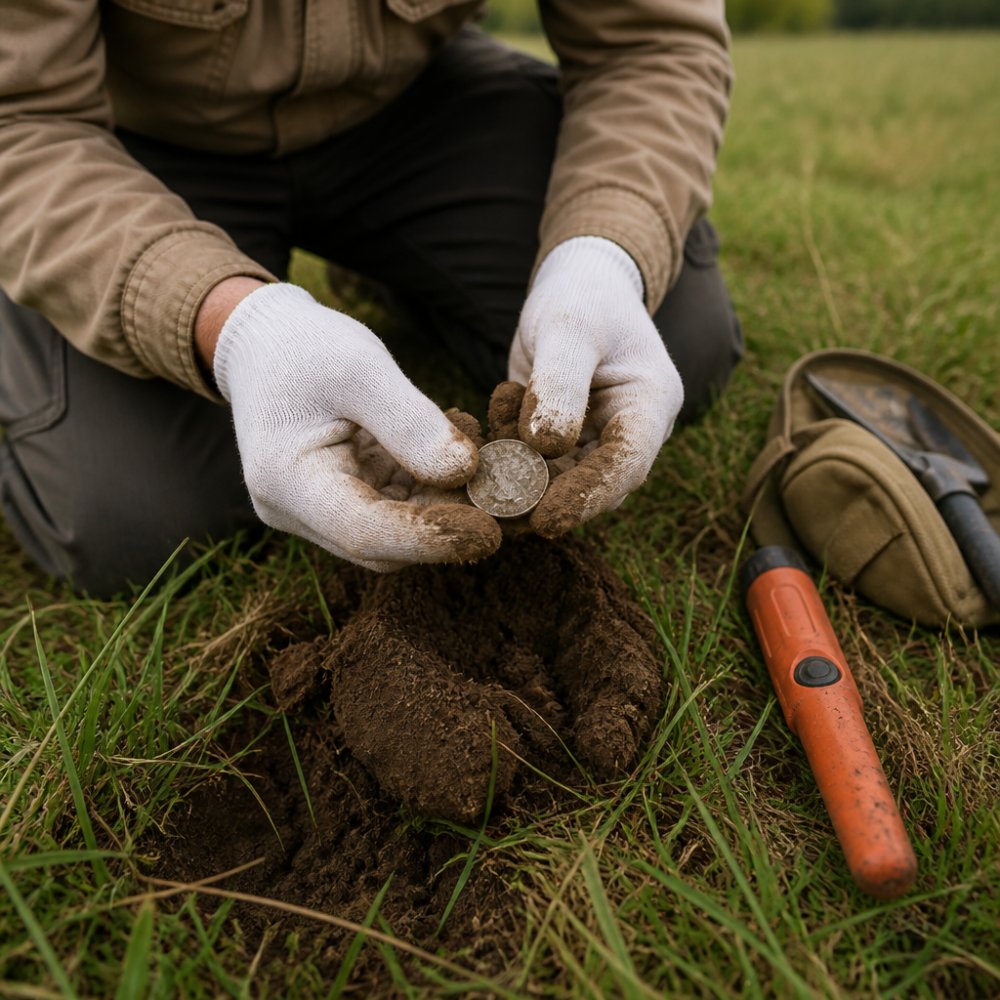
Follow these handling protocols on every dig:
- Lift the coin by the rim only. Your fingers should contact the edge, never the obverse or reverse.
- Never rub, wipe, or breathe on the surface. Moisture from breath accelerates tarnish.
- Place the coin directly into a padded container. A coin flip or a small padded box works; a loose pocket does not.
- Keep dirt on the coin until you get home. Dry-brushing in the field risks scratching.
- Photograph the coin in situ if you want a record of how it looked coming out of the ground.
Cotton gloves are worth carrying in your finds pouch. They prevent skin oils from transferring to the metal, and they cost almost nothing. For rim handling specifically, gloved fingertips give you enough grip without risking a drop.
How to Clean Silver Coins Without Damaging Them
Most dug silver coins should not be cleaned at all beyond a distilled water soak. That's the short answer, and it's the one professional conservators give most often. The longer answer depends on what's actually on the coin.
Distilled Water Soaking Methods
Distilled water is the safest first step because it contains no dissolved minerals that could deposit onto the coin. Tap water, by contrast, carries chlorine and trace metals that can react with silver.
The method:
- Place the coin in a non-metal container, glass or plastic.
- Cover it with distilled water at room temperature.
- Let it soak for 24 to 48 hours.
- Change the water daily.
- Remove the coin and let it air-dry on a soft, lint-free cloth. Do not rub.
Soaking duration matters. A day or two loosens most soil. Longer soaks rarely help and can begin to affect unstable surfaces. If the water turns cloudy, that's normal; it means the process is working.
Mechanical Cleaning vs. Chemical Cleaning
Mechanical cleaning uses physical force: brushes, picks, abrasives. Chemical cleaning uses reactive solutions. Both carry risk, but they fail in different ways.
| Method | What It Does | Risk Level | When It's Appropriate |
|---|---|---|---|
| Distilled water soak | Loosens soil without reaction | Low | Almost always, first step |
| Soft-bristle brush | Removes loosened dirt | Low-moderate | After soaking, on stable surfaces |
| Chemical dips | Strips tarnish chemically | High | Rarely; removes patina permanently |
| Abrasive polishing | Removes metal layer | Very high | Essentially never for collectible coins |
A soft-bristle brush used gently under running distilled water can lift remaining dirt from stable surfaces. Anything more aggressive should be a deliberate, informed choice, not a reflex.
Best Coin Storage Supplies for Metal Detectorists
Storage is where most collectors lose ground they fought hard to gain in the field. A coin that survives the dig and the soak can still corrode in a drawer over the next decade.
The core supplies worth having:
- Mylar capsules or inert plastic flips for individual coins
- Silica gel packs to control moisture in storage boxes
- Anti-tarnish strips that absorb sulfur compounds in the air
- Airtight, non-PVC containers
- A hygrometer to monitor relative humidity
Mylar Capsules and Silica Gel Packs
Mylar capsules are made from chemically inert film, meaning they won't off-gas the compounds that cheap PVC holders release. That matters because PVC breakdown products react directly with silver.
Silica gel packs manage moisture, and anti-tarnish strips handle the sulfur side of the equation. Together they address the two main drivers of ongoing corrosion in storage.
Storage environment targets: keep relative humidity low and stable, avoid temperature swings, and keep coins away from rubber, cardboard, and wood, all of which can release sulfur over time.
Long-Term Environmental Stabilization and Professional Conservation
Long-term stabilization is the part of coin conservation that separates a collection that holds value from one that quietly degrades. It's also the area where hobbyist advice is thinnest, most guides stop at "store it somewhere dry" and never define what dry means, how often to check, or when to call a professional.
The principle is straightforward: control the environment, not the coin. You can't undo corrosion, but you can stop it from progressing, and in some cases, a conservator can arrest active corrosion that home methods cannot.
Setting Concrete Storage Targets
Vague advice produces vague results. Use measurable targets instead:
- Relative humidity: keep stored coins in the 35-45% range. Below 30% risks stress on some materials; above 50% invites sulfide and chloride activity.
- Temperature: stable, room-temperature conditions. Avoid attics, garages, and basements where swings of 20°F or more are routine.
- Sulfur exposure: store away from rubber bands, wool, leather, cardboard, and most woods, all release sulfur compounds over time.
- Enclosure: inert holders only. Mylar and polyethylene are safe; PVC and many "soft" flips are not.
A simple hygrometer in the storage box turns guesswork into data. Replace silica gel when it changes color or every few months in humid climates, and swap anti-tarnish strips on the manufacturer's schedule rather than when you remember.
A Practical Inspection Cadence
Stabilization is a process, not a one-time event. A workable routine:
- Monthly: glance at stored coins for new tarnish blooms or color shifts.
- Quarterly: check the hygrometer reading and refresh desiccants as needed.
- Annually: pull each coin, photograph it under consistent lighting, and compare against the previous year's image. Slow changes are invisible day to day but obvious year over year.
Photographing on a fixed schedule is the single most useful habit here. It gives you an objective record of whether a coin is stable or still deteriorating.
Cleaning vs. Professional Conservation
The distinction most online advice blurs: cleaning removes material and is almost always irreversible. Conservation stabilizes condition without altering the surface. They are not the same activity, and they are not performed by the same people.
A conservator's toolkit includes stabilized treatments, controlled chemical reduction of corrosion products, chloride removal in sealed environments, and inert consolidation of flaking surfaces, that halt deterioration without stripping the coin. No home method reliably achieves this, and most home methods make things worse.
When to Stop and Call a Professional
Consider professional conservation when a coin shows any of the following:
- Active, spreading corrosion. Powdery green or gray deposits that reappear after cleaning indicate an ongoing chloride cycle. This is the clearest signal to stop handling the coin.
- High-grade detail under the dirt. If uncirculated or mint state surfaces are visible, the coin's value depends on preserving them. Amateur cleaning on a high-grade dug coin is the fastest way to turn a valuable find into a common one.
- Significant rarity or documented provenance. Coins with catalog value or historical association justify professional assessment before any intervention.
- Flaking or delaminating surfaces. Physical instability requires consolidation, not cleaning.
For everything else, common dates, low-grade dug silver, coins with stable patina, the correct answer is usually restraint. Soak in distilled water, store in inert materials with moisture and sulfur control, and leave the coin alone. If you'd rather not source supplies piecemeal, Treasure Coast Detectors, a trusted Google Top Tier Store, offers support before and after purchase if you're unsure which materials suit your coins.
The gap between amateur and professional handling is widest at the top end. A conservator's job is to preserve, not to make a coin look new. That's the opposite instinct from most cleaning advice you'll find online, and it's the correct one.
Frequently Asked Questions
Should you clean silver coins found in the ground?
Most dug silver coins should not be cleaned aggressively. Soil leaves a patina that many collectors value, and harsh cleaning can scratch the surface, remove mint luster, and lower numismatic value. If you must remove loose dirt, start with a distilled water soak and a soft-bristle brush. Coins that may be rare or uncirculated are best left to a professional conservator before you touch them.
What is the best way to remove dirt from dug silver coins?
Soak the coin in distilled water for several hours to loosen soil, then rinse gently. For stubborn dirt, use a soft-bristle brush with light pressure. Avoid tap water, which contains minerals and chlorine that can react with the silver surface. Never rub the coin between your fingers or use abrasive pads, and let it air dry on a soft cloth before storage.
Does soil acidity affect silver coin preservation?
Yes. Acidic soil speeds up oxidation and can pit the surface of a silver coin over time. Alkaline soil tends to leave a darker, more stable patina. The effects of soil pH on silver oxidation also depend on moisture, sulfur exposure, and trace elements in the ground. Coins from wet, acidic ground often need more careful conservation than those from dry, neutral soil.
How do you store silver coins to prevent further corrosion?
Use mylar capsules or inert holders, and keep coins away from sulfur, rubber, and paper with high acid content. Add silica gel packs to control relative humidity and anti-tarnish strips to absorb sulfur compounds. Store the collection in a cool, dark place with stable humidity. For metal detectorists, a sealed archival box with individual flips or capsules is the most reliable setup for long-term preservation.
Leave a comment