

Is the Minelab Equinox Good for Saltwater?
Table of Contents
- Minelab Equinox Performance in Saltwater Environments
- Multi-Frequency Technology and Conductive Ground
- Minelab Equinox Beach Settings Guide
- How to Stop Metal Detector False Signals in Saltwater
- Minelab Equinox Maintenance After Saltwater Use
- Recovery Speed, Target Separation, and Detecting Stability
- Verdict: Is the Equinox Right for Your Saltwater Hunting?
- Frequently Asked Questions
Last Updated: September 1, 2026
Minelab Equinox Performance in Saltwater Environments
Yes, the Minelab Equinox is one of the most capable multi-frequency detectors available for beach and shallow water hunting. Performance depends on which model you choose, how you configure it, and whether you understand saltwater's specific challenges. Saltwater presents unique challenges that separate capable detectors from mediocre ones. High conductivity creates electromagnetic noise that overwhelms single-frequency detectors. The Minelab Equinox's multi-frequency technology transmits multiple frequencies simultaneously, cutting through salt noise more effectively than single-frequency competitors. Unlike dry land hunting where mineralization is the main challenge, saltwater combines mineralization with ionic conductivity that masks targets and creates false signals.

Minelab Equinox Waterproof Headphones
Multi-Frequency Technology and Conductive Ground
Multi-frequency operation is the foundation of the Equinox's saltwater performance. Instead of transmitting a single frequency that can be masked by salt conductivity, the Equinox transmits multiple frequencies simultaneously. When some frequencies encounter salt noise, others continue detecting targets effectively.
The Equinox 900 operates across the full multi-frequency spectrum, while the Minelab Equinox 700 delivers the same multi-frequency advantage at a lower entry price. Both use Minelab's proprietary Multi-IQ technology, which intelligently adjusts how each frequency responds based on ground conditions. In highly conductive saltwater, the detector automatically emphasizes frequencies that penetrate salt noise while suppressing those that generate false signals.


Conductive ground works against single-frequency detectors because the ground itself becomes "hot" and creates a noisy baseline. Multi-frequency detectors solve this by using frequency diversity to separate legitimate targets from ground noise. Lower frequencies penetrate conductive ground more effectively, while higher frequencies add sensitivity to small targets. The Equinox balances both, giving you depth on larger targets and sensitivity on jewelry and coins.
The Equinox offers automatic ground balance, which continuously adjusts to changing conditions as you move from dry sand to wet sand to shallow water. Manual ground balance is also available for hunters who want precise control.
Minelab Equinox Beach Settings Guide
Configuring the Equinox correctly for beach hunting is where hunters either succeed spectacularly or waste their time digging trash. Start with these core configurations and adjust based on what you encounter.
Frequency Selection: In saltwater, avoid the highest frequencies (they generate more salt noise). Multi-IQ mode is the recommended starting point for any saltwater hunting.
Ground Balance: Use automatic ground balance as your default. If you're experiencing erratic signals in extreme salt concentration, switch to manual ground balance and set it to a stable baseline in wet sand.
Sensitivity (Gain): Start at 75-80% sensitivity and increase only if you're not detecting targets at your target depth. Many successful beach hunters run 70-75% sensitivity in heavy salt conditions.
Discrimination: Beach hunting typically uses light discrimination to reject pull-tabs and aluminum foil without missing deep coins or jewelry. A discrimination level of 1-3 rejects most ferrous trash while keeping you open to valuable targets.
Target ID: The Equinox's 119-point target ID system is one of its strengths. In saltwater, target ID becomes less reliable on deep targets because salt noise can distort the signal. Dig based on audio response and depth reading for deeper targets.
Audio Tone: Set audio response to a mode that gives clear feedback on target strength. Two-tone or multi-tone audio helps you distinguish between strong targets (likely valuable) and weak signals (possibly trash or deep targets).
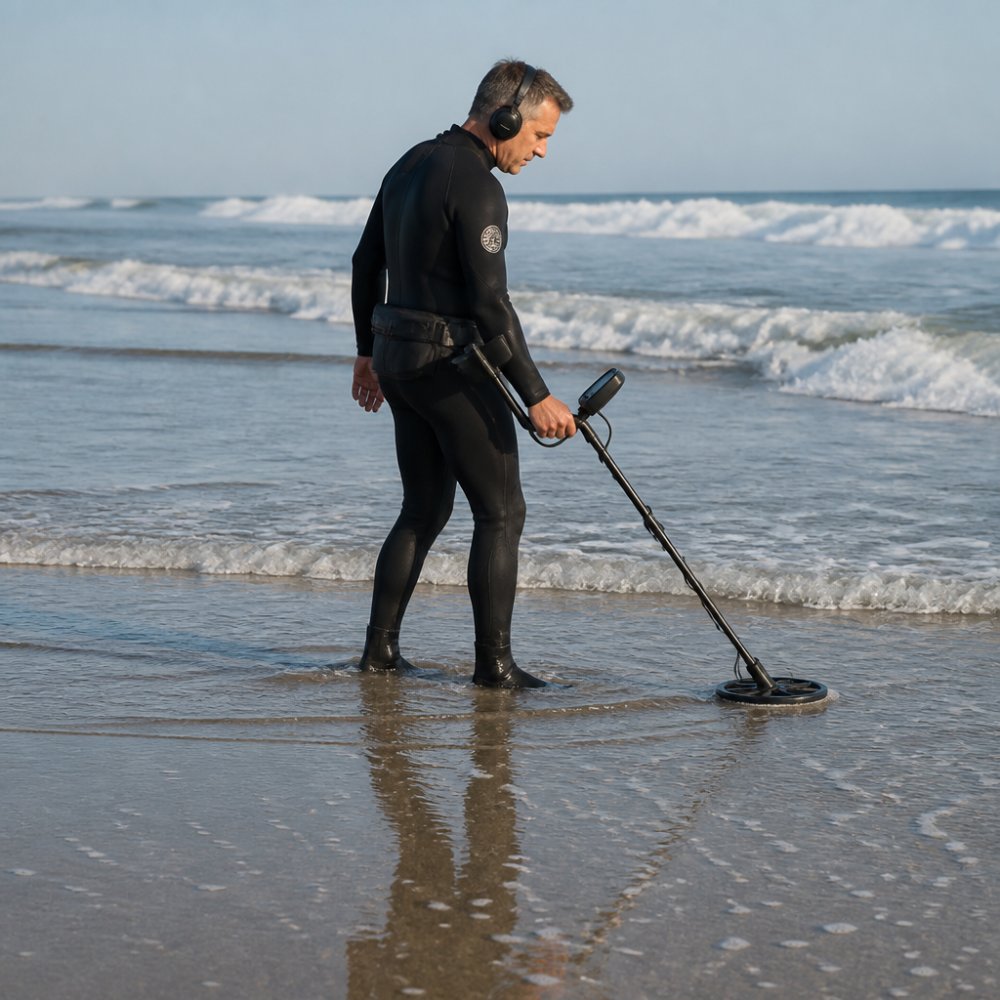
Beachcomber in wetsuit using Minelab Equinox detector in shallow surf zone with waves breaking in background and wet sand surrounding their feet
Wet Sand vs. Dry Sand Performance
Wet sand is conductive, meaning the detector sees it as "hot" ground. Dry sand above the waterline has minimal conductivity, so the detector baseline is quieter. The Equinox's automatic ground balance compensates for this shift.
In wet sand, expect reduced depth compared to dry sand. Conductivity of saltwater-saturated sand absorbs electromagnetic energy, limiting penetration. A target that reads 8 inches deep in dry sand might only reach 5-6 inches in wet sand. Dry sand above the tide line offers better depth but often presents higher mineralization, which the Equinox's ground balance handles well.
The transition zone between wet and dry sand is where many hunters find the most targets. The Equinox's continuous ground balance adjustment means you can sweep through this zone without stopping to recalibrate.
Waterproof Depth Ratings and Submersible Capabilities
The Minelab Equinox is waterproof to 16 Ft for the detector body and coil. Practical hunting depth in saltwater is typically 3-6 feet in the surf zone. Most beach hunters work in water from ankle-deep to chest-deep, where the Equinox performs optimally.
Standard headphones are not waterproof. If you're planning to hunt in shallow water with the detector partially submerged, invest in Minelab Equinox Waterproof Headphones, which are submersible to 200 feet. Check the seal regularly, especially after saltwater use, and clean the seal area before closing the battery compartment after each hunt.
How to Stop Metal Detector False Signals in Saltwater
False signals in saltwater are the most common frustration for Equinox users. Salt noise creates erratic beeps that sound like targets but yield nothing when you dig. Understanding the causes helps you eliminate most false signals through proper configuration.
Threshold Adjustment: Set the threshold to a barely audible hum, just loud enough that you notice if it disappears. If threshold is too loud, every fluctuation in salt noise triggers a false signal.
Sensitivity Reduction: False signals often indicate sensitivity is too high. Lower sensitivity by 5-10% increments until false signals stop. Most saltwater hunters find their optimal sensitivity through trial and error, starting at 75% and adjusting based on false signal frequency.
Ground Balance Precision: Incorrect ground balance is a primary cause of false signals. In extreme salt conditions, manual ground balance gives better results. Set it by placing the coil on wet sand and triggering the ground balance function in the area where you'll hunt.
Coil Selection: Smaller coils (6-8 inches) generate less salt noise than larger coils (11+ inches), but sacrifice depth and coverage. Many saltwater hunters use a smaller coil specifically for beach hunting.
Audio Response Mode: Two-tone or multi-tone modes often produce false signals in saltwater. Switch to single-tone mode if false signals persist.
Minelab Equinox Maintenance After Saltwater Use
Saltwater is corrosive, and the Equinox requires specific maintenance to prevent damage and extend its lifespan.
Immediate Rinse: After every saltwater hunting session, rinse the entire detector with fresh water, control box, coil, shaft, and headphone connections. Pay special attention to the battery compartment seal and any crevices where salt can accumulate.
Coil Maintenance: Coils are the most exposed part and most vulnerable to corrosion. After rinsing, dry the coil thoroughly with a cloth. Inspect the coil cable where it connects to the shaft. If you see white or green oxidation, clean gently with a soft brush and apply a thin coat of silicone-based corrosion inhibitor. Make sure you remove the skidplate and hose it off to remove all the sand that has accumulated between coil and the cover.
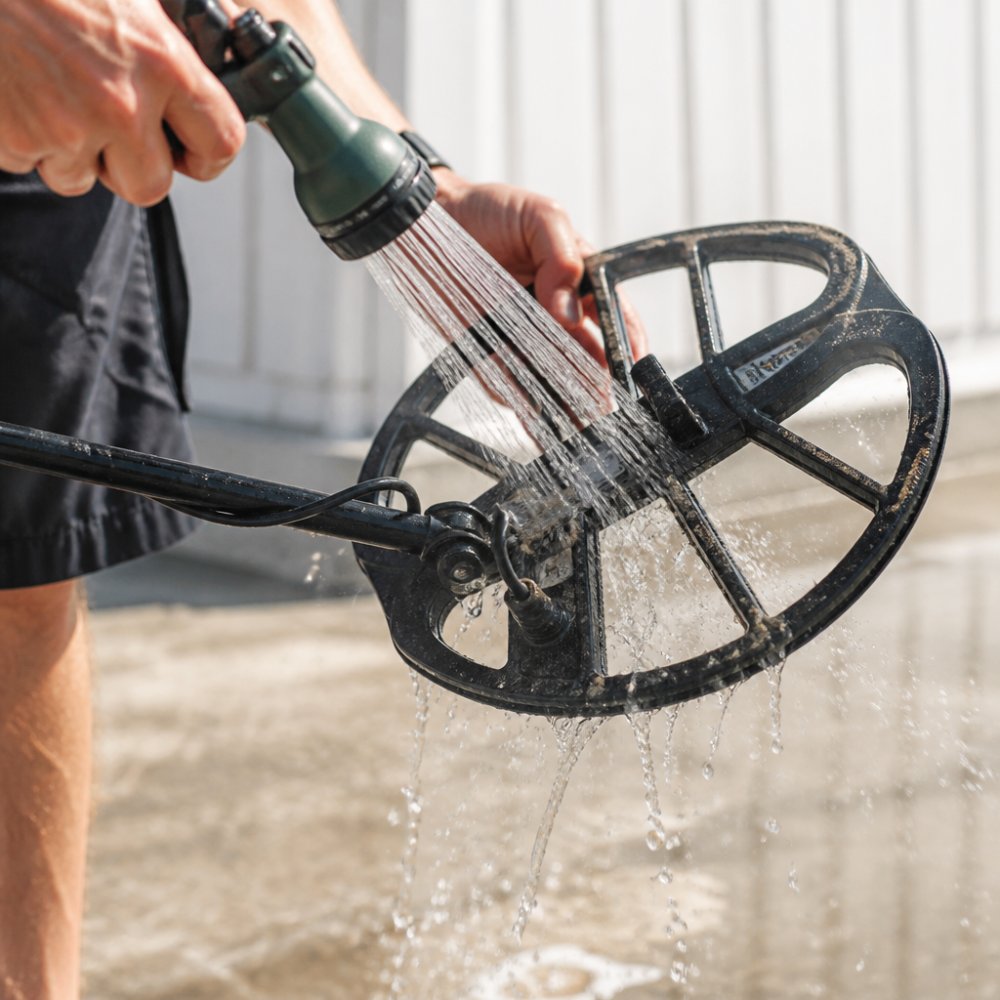
Close-up of hands rinsing metal detector coil with fresh water from hose, showing water streaming over coil surface and sand particles washing away
Storage: Store the Equinox in a dry location, ideally in a padded bag or case. In humid coastal environments, consider storing the detector with silica gel packets inside the case to absorb moisture.
Recovery Speed, Target Separation, and Detecting Stability
Recovery speed is how quickly the detector resets after detecting a target. In saltwater, fast recovery speed is crucial because salt noise creates a noisy baseline. The Equinox's recovery speed is one of its strengths, it resets quickly enough to handle dense target areas without masking signals.
Target separation refers to the detector's ability to distinguish between two targets in close proximity. In saltwater, where signals are already degraded by salt noise and conductivity, target separation becomes more difficult. The Equinox handles this better than most detectors because multi-frequency operation provides cleaner signal processing. However, targets within 2-3 inches of each other will often blend into a single signal, especially at depth.
Detecting stability is the consistency of the detector's baseline and signal response. The Equinox's automatic ground balance maintains stability better than manual-balance detectors. Check your threshold audio every 15-20 minutes; if it's drifting higher or becoming erratic, pause and reset ground balance.
In dense trash areas, the Equinox's fast recovery means you can hunt these areas more effectively than slower detectors. When hunting near old piers or wrecks where targets cluster, the Equinox's recovery speed gives you an advantage.
Verdict: Is the Equinox Right for Your Saltwater Hunting?
The Minelab Equinox is genuinely good for saltwater hunting. It's one of the few detectors that consistently performs in high-conductivity environments. The multi-frequency technology, fast recovery speed, and stable ground balance make it a top choice for beach hunters and shallow-water prospectors. But it's not a magic solution for poor technique.
The Equinox excels if you're willing to learn proper configuration. Hunters who spend time testing different settings in their local conditions see excellent results. For serious beachcombers frustrated with their current detector's saltwater performance, the Equinox is a solid upgrade. For beginners, the Minelab Equinox 700 offers the same multi-frequency advantage at a lower price point than the Equinox 900.
When you purchase from Treasure Coast Detectors, you gain access to support before and after purchase, ensuring you get the most from your detector. We help you configure it correctly, match it to your specific hunting environment, and troubleshoot issues before they become frustrations. We're also a trusted Google Top Tier Store, making it easy to find us when you're ready to invest in quality equipment and expert guidance.
Is the Minelab Equinox good for saltwater? Yes. Will it work perfectly out of the box? Probably not. Will it deliver excellent results once you understand how to use it? Absolutely. That's why serious saltwater hunters keep coming back to the Equinox year after year.
|
Feature |
Equinox 900 |
Equinox 700 |
Best For |
|---|---|---|---|
|
Multi-Frequency Technology |
Yes |
Yes |
Both handle salt noise equally well |
|
Target ID Resolution |
119 points |
119 points |
Same performance |
|
Waterproof Depth |
5 meters |
5 meters |
Same submersible capability |
|
Price |
$999 |
$749 |
Budget-conscious hunters start with 700 |
|
Coil Options |
Multiple coils included |
Single coil |
900 offers more flexibility |
|
Battery Life |
8-10 hours |
8-10 hours |
Same endurance |
Frequently Asked Questions
What makes the Minelab Equinox effective in saltwater environments?
The Equinox uses Multi-IQ technology, which transmits multiple frequencies simultaneously to handle conductive saltwater and mineralized ground better than single-frequency detectors. This multi-frequency approach reduces salt noise and electromagnetic interference while maintaining target separation even in challenging surf zone conditions. The detector's ground balance automatically adapts to changing saltwater conductivity, keeping your detecting stability consistent whether you're in wet sand or shallow water.
How do I adjust my Equinox settings for wet sand versus dry sand?
For wet sand, use Beach Mode 1 or 2 with increased noise cancel and sensitivity set to manage salt conductivity. In dry sand, you can run higher sensitivity with standard Ground Balance. Wet sand requires more aggressive iron bias settings to filter out mineralization, while dry sand allows more aggressive all-metal detection. Test your threshold audio response in both conditions before hunting to ensure you're not masking weak signals from deep targets.
How do I prevent false signals while detecting in saltwater?
False signals in saltwater typically come from salt noise or rapid ground conductivity changes. Reduce them by enabling Noise Cancel, lowering sensitivity if the threshold is unstable, and using Beach Mode specifically designed for conductive environments. Move your coil smoothly and consistently—jerky motions trigger false signals in mineralized ground. If you're getting audio response to every sweep, your sensitivity may be too high. Adjust sensitivity as needed.
Does saltwater affect the depth performance of the Minelab Equinox?
Saltwater's high conductivity reduces target detection depth compared to dry land, but the Equinox handles this better than most detectors. You'll typically see reduced depth in saltwater than in mineralized soil, though larger targets can still be found. The Multi-IQ technology compensates by maintaining signal clarity even at reduced depths. Using a smaller coil can improve recovery speed and target separation in salty conditions, while a larger coil sacrifices some depth for wider coil coverage of the beach.
Leave a comment