

Where to Metal Detect for Beginners on Public Land
Table of Contents
- Start With the Right Mindset: Legal Spots Beat Secret Spots
- How to Research Public Land for Metal Detecting
- Top Beginner Spots: Parks, Beaches, and Designated Areas
- Metal Detecting Laws by State: Where to Look
- Best Entry Level Metal Detector for Public Land
- Common Mistakes to Avoid on Public Land
- Conclusion: Your First Hunt Starts With Permission
- Frequently Asked Questions
Last Updated: September 5, 2026
Start With the Right Mindset: Legal Spots Beat Secret Spots
The biggest question for newcomers is where to metal detect on public land without risking fines, confiscated gear, or a ruined reputation. The answer is simpler than most forum threads suggest: start with locations where permission is clear and documented. At Treasure Coast Detectors, we tell every first-time buyer the same thing: the best detector in the world is useless if you cannot legally swing it.
Metal detecting on public land is a privilege governed by layers of federal, state, and local rules. A common approach is to assume that "public" means "open," but that assumption leads to trespassing violations and the seizure of equipment. Federal agencies manage land under distinct mandates, and what is allowed in a national forest often differs sharply from a national park, where the National Park Service's regulations on preserving archaeological resources prohibit virtually all metal detecting. Your first hunt should be a research session at home, not a walk into the nearest green space.
The good news is that legal, productive spots are abundant. Public parks, school grounds (when school is out), and designated recreation areas offer consistent finds like coins and jewelry. Below, we show you exactly how to verify your rights, where to start, and which entry-level detector makes the process frustration-free.
How to Research Public Land for Metal Detecting
Researching where you can hunt is a two-part process: identify the land manager, then read that agency's specific rules. Policies are not uniform, and municipal ordinances vary from town to town. A city park may require a permit, while a county beach might have no restrictions at all.
Start by identifying the owner of the property. Use GIS mapping tools and property boundary apps to confirm whether a parcel is city, county, state, or federal land. This step is critical because trespassing laws apply even when you are on land that looks abandoned or public. The U.S. Forest Service's guidelines for metal detecting on national forests explain that surface hunting is generally permitted in designated areas, but digging into archaeological sites is a federal offense.
A Simple 4-Step Legal Verification Workflow
Follow this workflow before every new location to keep your hobby legal and your reputation clean:
- Identify the managing agency. Search the property address or name plus "managed by" to find the owner (city parks department, state DNR, county, or federal bureau).
- Check the agency website for rules. Look for pages about "recreational activities," "metal detecting," or "permit requirements." If the page does not mention detecting, call the office directly.
- Verify local municipal ordinances. City and county codes often restrict detecting in parks even when state or federal rules allow it. Search "[city name] municipal code metal detecting."
- Document your permission. Print the relevant rule page or save the email from a ranger or official. Carry it with you on your first hunt in case another visitor or officer questions you.
Top Beginner Spots: Parks, Beaches, and Designated Areas
The best terrain for beginners is high-traffic public space where people lose items. The difference between a productive first hunt and a frustrating one comes down to three variables: soil condition, turf management schedule, and the specific zone where items accumulate.
City Parks: Target the 'Drop Zones,' Not the Whole Lawn
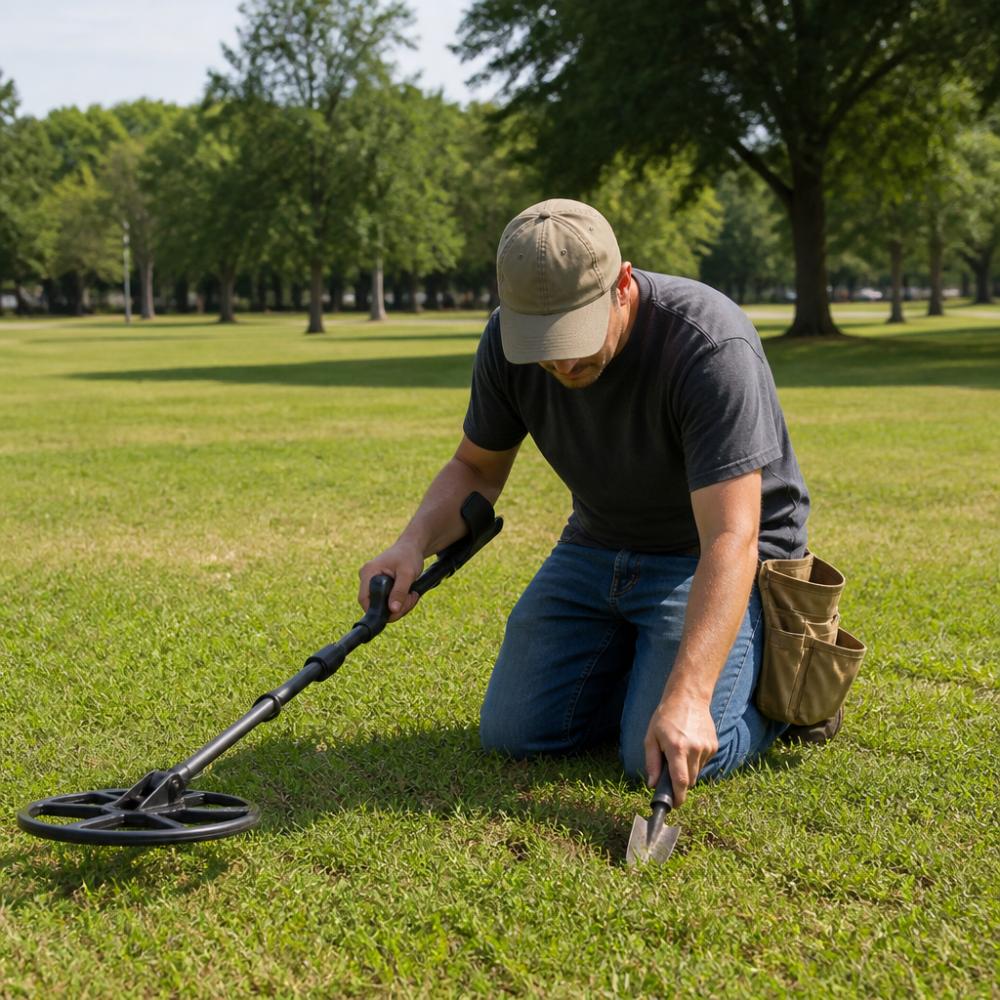
City parks with playing fields, picnic areas, and walking trails are ideal starting points for coin shooting. Focus on where people sit, stand, and transition, not the open field center. Target the first 10 feet inside a baseball diamond's perimeter, the base of park benches, the edges of picnic pavilions, and the ground under playground swings. These 'drop zones' concentrate lost items because people are stationary or moving slowly. Beginners walk the entire field and dig sporadic signals; experienced detectorists grid the high-traffic margins and recover three times the targets.
Seasonal Timing: When Parks Are Open to Digging
Many municipalities restrict detecting during turf maintenance season, typically spring and early summer. Fall and winter hunts are often more welcome because the ground is firmer and the turf is dormant. Check the park's maintenance schedule and look for signs of recent aeration (small soil plugs) or reseeding (straw mulch or yellow-green new grass); hunting a freshly aerated or reseeded park is a quick way to get banned. The optimal window for most of the northern half of the country is October through November and March through April. In warmer climates, winter months are prime because summer heat hardens the ground.
Beaches: The High-Tide Line Is the Target
Beaches are another forgiving starting point. Public access points below the high tide line are often open to detecting, and wet sand hunting avoids turf damage concerns. The most productive zone is the 'wet-dry line', where the last high tide deposited debris and swimmers drop items as they transition from sand to water. Beginners often hunt the dry sand near the boardwalk, which is trash-filled and picked over. Instead, walk to the water's edge at low tide and grid the wet sand parallel to the shoreline. Check the city's beach ordinance first; some communities restrict detecting to certain hours or require a daily permit from the lifeguard station.
Visual Identification of Restricted Zones
Beginners often fear trespassing, but the opposite problem is more common: missing the visual cues that a zone is off-limits. Look for these indicators before you swing:
- Crossed-out shovel icons on signs, this is the universal symbol for 'no digging.'
- 'Preserve the Turf' or 'No Disturbing Vegetation' language on park entrance signs.
- Orange construction fencing or flagging around a field, this indicates recent seeding or irrigation work.
- Small brass or aluminum markers flush with the ground, these often mark buried sprinkler heads, utility lines, or archaeological survey points. Stay at least 10 feet clear of any flush-mounted marker.
- Interpretive signs or historical markers, most parks prohibit detecting within a set radius (often 50 feet) of any historical monument or interpretive display.
State Parks: The Advanced Step
State park regulations are stricter and less predictable. Some states allow detecting on state park beaches but prohibit it in campgrounds or near historical structures. A quick call to the park office saves a wasted trip and a potential fine. Beginners should skip state parks until they understand the etiquette. When you graduate to state parks, ask for the specific 'public use' regulation number covering detecting and carry a printed copy.
Metal Detecting Laws by State: Where to Look
A common mistake is searching for a single national rule when metal detecting laws by state vary significantly. There is no federal statute granting a blanket right to detect on all public land; authority splits between state agencies and federal land managers. State-level rules are rarely published on a single 'metal detecting' page, they are buried in administrative codes, park system regulations, or historic preservation statutes. Here is the workflow that cuts through the noise.
Step 1: Identify the State Land Manager
For state-owned land, state parks, state forests, wildlife management areas, and state recreation areas, the managing agency is almost always one of three types:
- Department of Natural Resources (DNR) or Department of Fish and Wildlife - These agencies manage state parks, forests, and wildlife areas. Their websites typically have a 'Rules and Regulations' or 'Recreational Activities' section.
- State Historic Preservation Office (SHPO) - This office enforces state antiquities acts. Even if the DNR allows detecting, the SHPO may restrict it on lands containing recorded archaeological sites. Search '[your state] SHPO metal detecting' to see if your state has a specific policy.
- State Lands Commission or Board of Land Commissioners - These agencies manage school trust lands and other state-owned parcels not in the park system. Leases or permits are often required.
Step 2: Search the State Administrative Code, Not Just the Website
Agency websites are often outdated. The authoritative source is the state administrative code. Use this search pattern: [state] administrative code metal detecting or [state] administrative code archaeological resources. Many states prohibit 'excavation, removal, or damage to archaeological resources' on state land even if surface detecting is not explicitly banned. Knowing this distinction, surface detecting allowed, digging prohibited, is the difference between a legal hunt and a felony citation.
Step 3: Check for a Statewide Permit System
A handful of states operate a centralized permitting system for metal detecting on state lands. For instance, some states issue a general 'recreation permit' that covers detecting, while others require a separate 'archaeological resources permit' that is only granted for research purposes. The National Association of State Park Directors' directory of state park agencies gives you the direct contact for each state's park agency. Call the main office and ask two questions: 'Is metal detecting allowed on state park lands?' and 'Is a written permit required, or is it a general allowance?' Do not rely on a ranger's verbal opinion; ask for the specific code section or policy document number.
Step 4: Federal Land Is a Separate Layer
For federally managed land, the rules depend on the agency. National forests and Bureau of Land Management (BLM) holdings generally allow surface metal detecting without a permit under their 'recreational mineral collecting' provisions, but prohibit digging into archaeological resources or disturbing historical artifacts. National parks, national monuments, and most wildlife refuges prohibit detecting entirely under the Archaeological Resources Protection Act and the National Historic Preservation Act. The Bureau of Land Management's recreation page updates activity restrictions regularly, so check the official source each season.
A Practical Example of the Workflow
Suppose you want to hunt a state forest in the Midwest. You would: (1) confirm the forest is managed by the state DNR, not a county or private timber company; (2) search the DNR's 'Rules for State Forests' page for 'metal detector'; (3) if silent, call the DNR law enforcement division for the specific administrative rule number; (4) check the state SHPO website for archaeological site restrictions; and (5) document the rule number and date in a note on your phone. This 20-minute workflow converts a vague 'maybe' into a documented 'yes.'

Best Entry Level Metal Detector for Public Land
Your first detector should be forgiving, waterproof, and capable of handling the mineralized soil common in public parks. The best entry level model offers preset modes for coin shooting and relic hunting, plus automatic ground balance so you are not fighting the machine while you learn target identification.
The Nokta Makro Simplex Ultra Metal Detector at $299 is the benchmark for entry-level value. It is fully waterproof, which means a rain shower or shallow water hunt will not end your session. Its discrimination modes let you filter out bottle caps and pull tabs, addressing the frustration of digging trash all afternoon.
For a slightly higher budget, the Minelab X-TERRA PRO Metal Detector at $295 brings manual frequency selection to the table. This is a genuine advantage on public land because different frequencies handle soil mineralization and trash differently. You can run a lower frequency for deeper coin shooting in clean soil, then switch to a higher frequency to pick out small gold jewelry in a trashy park.

Common Mistakes to Avoid on Public Land
The most common mistake beginners make is digging before verifying the rules. A close second is failing to read the signs. Many parks post "No Digging" or "Preserve the Turf" notices at entrances; detecting under those signs is a fast way to lose your hobby privileges. Look for crossed-out shovel icons or language about "disturbing vegetation."
Another frequent error is poor hole recovery. Digging a plug, flipping it out, and leaving it to dry kills the grass and draws complaints. Use a sheath knife or digger to cut a clean three-sided plug, hinge it back, and replace it firmly after retrieving your target. Leave no trace means the next visitor should never know you were there.
Finally, do not skip seasonal timing. Many municipalities restrict detecting during turf maintenance season, typically spring and early summer. Fall and winter hunts are often more welcome because the ground is firmer and the turf is dormant. Hunting a freshly aerated or reseeded park is a violation of etiquette and a quick way to get banned.
| Mistake | Consequence | The Fix |
|---|---|---|
| Skipping local ordinance checks | Citation or gear confiscation | Run the 4-step verification workflow |
| Digging near signs or fixtures | Damage to park infrastructure | Stay 10 feet clear of posts, sprinklers, and trees |
| Leaving unfilled holes | Park bans detecting entirely | Cut clean plugs and restore every hole |
| Hunting during reseeding season | Grass damage and complaints | Hunt in fall or winter on established turf |
Conclusion: Your First Hunt Starts With Permission
The challenge of metal detecting on public land is not finding a place to swing; it is proving you have the right to be there. Every park, beach, and forest has its own rules, and the responsibility to know them rests on you. Start with local parks and beaches, verify regulations through official channels, and build a habit of leaving every site exactly as you found it.
At Treasure Coast Detectors, we support detectorists before and after the purchase. As a Google Top Tier Store, we help you match the right machine to your local terrain, whether that is a waterproof beginner model for the beach or a frequency-flexible unit for mineralized park soil. Get started with Treasure Coast Detectors and make your first hunt a legal, productive one.
Frequently Asked Questions
Where can I metal detect for free?
Your own front yard is always free. After that, start with local public parks, school grounds (when school is out), and public beaches. Check the city or county website for municipal ordinances first. Many parks allow detecting on grass areas but prohibit it on athletic fields or historical sites. Always call the local parks and recreation department to confirm before you go.
What are the metal detecting laws by state for public land?
Laws vary significantly by state. State parks generally require a permit or prohibit detecting entirely. Federal land is managed by agencies like the BLM and National Park Service, with strict rules. The best approach is to check the specific land management agency website for the area you plan to hunt. Look for terms like 'metal detecting' or 'recreational prospecting' in their regulations.
What is the best entry level metal detector for public land?
The Nokta Makro Simplex Ultra at $299 is an excellent starting point. It is fully waterproof, handles mineralized soil well, and offers preset modes for parks, fields, and beaches. The Minelab X-TERRA PRO at $295 is another strong option with manual frequency selection. Both give you the depth and target ID needed to learn without a high investment.
Are there restrictions for metal detecting on National Forest land?
Yes. In most National Forests, casual metal detecting is allowed in designated areas without a permit, but you cannot disturb archaeological sites or remove historical artifacts. The rules change if you are prospecting for minerals or gold, which requires a permit. Always check with the local ranger district office for the specific forest you plan to visit.
Leave a comment